India’s retail industry is one of the fastest-growing sectors in the world, driven by rising incomes, expanding urban markets, and increasing digital adoption. Whether you’re planning to open a neighbourhood grocery store, a fashion boutique, or a multi-city supermarket chain, one document decides how far your idea will go: your retail business plan.
A well-written retail business plan isn’t just paperwork for investors or banks. It’s a working roadmap that helps you validate your idea, control costs, plan inventory, and scale with confidence. In this guide, we’ll walk you through exactly how to write a retail business plan in India, including a practical template you can use right away.
What Is a Retail Business Plan?
A retail business plan is a formal document that outlines your store concept, target customers, competitive positioning, operational structure, marketing approach, and financial projections. It answers three fundamental questions that every retailer, lender, or investor wants to know:
- What are you selling, and to whom?
- How will you make money, and how much?
- What makes your retail business sustainable in a competitive market?
Unlike a generic business plan, a retail-specific plan pays special attention to footfall, inventory turnover, seasonal demand, store location, and point-of-sale operations – the factors that make or break a retail business in India’s price-sensitive, high-competition market.
Why a Retail Business Plan Matters for Indian Retailers
Many small and mid-sized retailers in India start operations without a formal plan, relying instead on instinct and word-of-mouth demand. This works initially but often leads to stockouts, cash flow problems, and missed growth opportunities. A solid business plan helps you:
- Secure funding from banks, NBFCs, or investors with clear financial projections
- Choose the right store format and location backed by market research
- Plan working capital and avoid inventory mismanagement
- Set realistic sales targets and marketing budgets
- Prepare for GST registration, licensing, and other regulatory compliance from day one
- Create a scalable structure if you plan to expand to multiple stores later
If you’re also exploring where your store fits – a hypermarket, supermarket, grocery store, boutique, or specialty format – it helps to study formats similar to yours before finalising your plan.
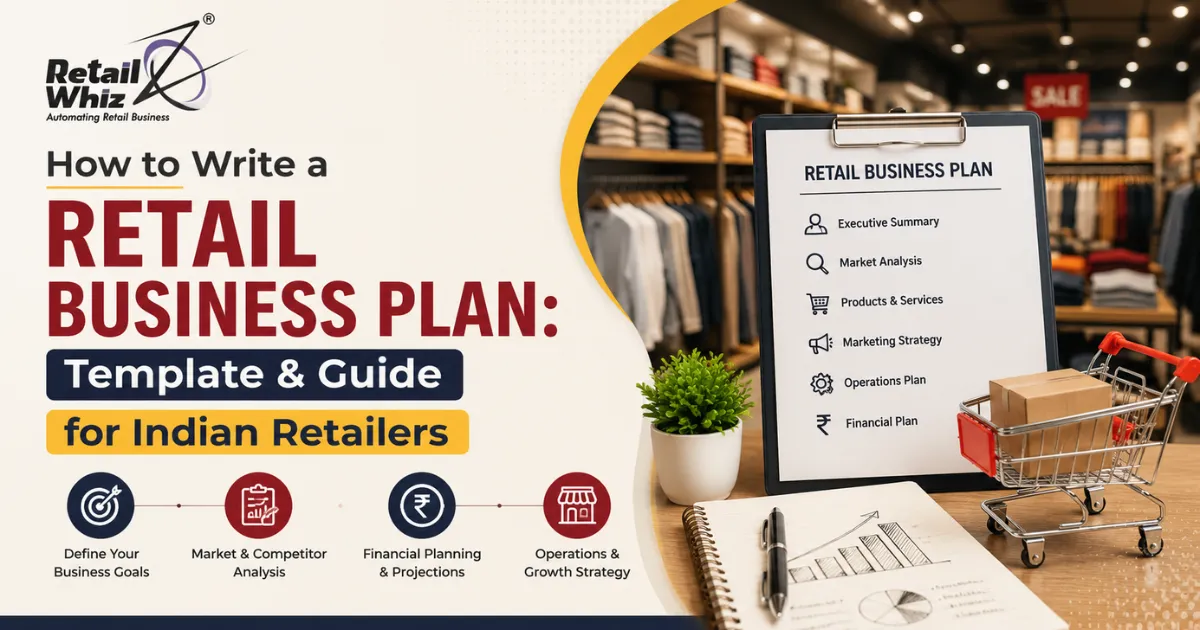
Key Components of a Retail Business Plan Template
Every strong retail business plan template includes the following sections. Use this as your working outline.
1. Executive Summary
This is a one-page snapshot of your entire plan – your business name, concept, location, target market, and funding requirement. Even though it appears first, write it last, after you’ve completed the rest of the plan. Keep it concise enough for a lender to understand your business in under two minutes.
2. Business Description
Describe your retail store in detail: the legal structure (proprietorship, partnership, or private limited), ownership, store format (standalone store, mall outlet, franchise, or online-plus-offline), and the specific retail category you operate in – grocery, fashion, electronics, pharmacy, home décor, or F&B.
3. Market Analysis
This section proves you understand your customers and competitors. Include:
- Target customer demographics (age, income, buying behaviour)
- Local market size and demand trends
- Competitor analysis – direct and indirect competitors nearby
- Industry trends affecting retail in India, such as GST changes, omnichannel shopping, and quick commerce
4. Products and Services
List your core product categories, pricing strategy, supplier relationships, and any unique selling proposition – for example, exclusive brands, better pricing, or superior customer service.
5. Organization and Management
Outline your team structure – store manager, sales staff, cashiers, and back-office roles. If you’re a solo founder initially, mention your plan to hire as the business scales.
6. Marketing and Sales Strategy
Detail how you’ll attract and retain customers: local advertising, social media, loyalty programs, festive promotions, and referral incentives. Indian retail is highly relationship-driven, so customer retention strategies deserve special attention here.
7. Operations Plan
This is where retail plans differ significantly from generic business plans. Cover:
- Store layout and space planning
- Inventory management and reorder processes
- Vendor and procurement workflows
- Billing, point-of-sale systems, and checkout efficiency
- Staff scheduling and shift management
8. Financial Plan
Your financial plan should include:
- Startup costs (rent, interiors, initial inventory, licenses)
- Monthly operating expenses
- Sales forecasts for the first 1–3 years
- Break-even analysis
- Profit and loss projections
- Funding requirements and repayment plan (if applicable)
Lenders and investors scrutinise this section the most, so back every number with realistic assumptions rather than optimistic guesses.
Step-by-Step Guide to Writing a Retail Business Plan in India
Step 1: Define Your Retail Concept Clearly
Before writing anything, be precise about what you’re selling, your store format, and your target locality. A vague concept leads to a vague plan.
Step 2: Research Your Local Market and Competition
Visit competing stores, study their pricing, footfall patterns, and product range. Combine this with secondary research on industry trends to strengthen your market analysis section.
Step 3: Choose the Right Location
Location decides 50% of retail success in India. Factor in footfall, accessibility, parking, nearby residential density, and rental costs relative to expected revenue.
Step 4: Plan Your Inventory and Supplier Network
Identify reliable suppliers, negotiate credit terms, and plan your initial inventory mix based on demand forecasting rather than guesswork.
Step 5: Build Your Financial Projections
Use conservative sales estimates for the first six months, since new stores typically take time to build a steady customer base. Include GST, rent, salaries, utilities, and marketing in your monthly expense sheet.
Step 6: Plan Store Operations and Technology
Decide how you’ll manage billing, inventory tracking, and daily sales reporting. Many first-time retailers underestimate how much time manual processes consume – this is where the right retail technology stack becomes essential (more on this below).
Step 7: Draft, Review, and Refine
Write the full plan using the template above, then review it against your goals. If you’re seeking funding, have an accountant or retail consultant review your financial assumptions before submission.
Free Retail Business Plan Template: Quick Outline
Use this checklist as your working template:
- Executive Summary
- Business Description & Store Format
- Market & Competitor Analysis
- Products, Pricing & Suppliers
- Organization & Staffing Plan
- Marketing & Customer Retention Strategy
- Store Operations & Technology Plan
- Financial Projections & Funding Requirement
- Risk Analysis & Contingency Plan
- Appendix (licenses, vendor agreements, layout plans)
Common Mistakes Indian Retailers Make While Writing a Business Plan
- Overestimating sales projections without market validation
- Ignoring working capital needs for inventory and seasonal stock-ups
- Underestimating GST and compliance costs in the financial plan
- Skipping competitor research, leading to unrealistic pricing strategy
- Treating the plan as a one-time document instead of updating it as the business grows
- Not planning for technology and billing systems until operations are already underway, causing chaos during peak footfall
How Retail ERP Software Simplifies Business Planning and Execution
A business plan is only as good as your ability to execute it. Once your store is operational, the biggest challenges shift from planning to daily execution – accurate billing, inventory visibility, GST compliance, and customer retention. This is where a dedicated retail ERP and POS system becomes critical.
For instance, a reliable POS software ensures fast, error-free billing and real-time sales tracking right from day one, which directly supports the operations plan in your business plan. Similarly, inventory management software helps you avoid the stockouts and overstocking issues that new retailers commonly face, while purchase and procurement software streamlines your supplier and vendor workflows outlined in your operations section.
To execute the marketing and retention strategy you’ve planned, a loyalty program software can help convert first-time buyers into repeat customers – a key driver of profitability highlighted in most financial plans. For accepting payments smoothly across formats, integrating a payment gateway solution is essential for modern Indian retail.
On the compliance side, staying updated with GST and compliance management tools saves you from the regulatory pitfalls many new retailers underestimate in their financial planning. And once your store is live, MIS and analytics tools give you the real-time business insights needed to compare actual performance against the projections in your plan – helping you course-correct quickly.
If you’re unsure how to translate your business plan into an operational retail setup, professional retail consultancy services can guide you through implementation, while retail ERP implementation support ensures your systems are set up correctly from launch. Retailers migrating from manual or legacy systems can also benefit from structured retail data migration to avoid data loss during the transition.
For a deeper look at choosing the right billing and inventory system for your new store, this comparison of the best POS software for retail stores in India is a useful next read.
Conclusion
Writing a retail business plan is one of the most important steps you’ll take before opening your store – it forces clarity on your concept, market, operations, and finances, while giving lenders and partners confidence in your venture. Use the template and steps in this guide to build a plan that’s realistic, detailed, and ready for execution.
Once your plan is in place, the right technology partner can help you execute it smoothly from day one. Get in touch with RetailWhizz to see how our retail ERP and POS solutions can support your new store’s operations, compliance, and growth.
Frequently Asked Questions
1. What should be included in a retail business plan?
A retail business plan should include an executive summary, business description, market and competitor analysis, product and pricing details, marketing strategy, operations plan, and detailed financial projections including startup costs and break-even analysis.
2. How long should a retail business plan be?
For most small to mid-sized retail stores in India, a business plan of 10–20 pages is sufficient. It should be detailed enough to guide operations and satisfy lenders, without unnecessary padding.
3. Do I need a business plan to get a loan for my retail store in India?
Yes, most banks and NBFCs require a formal business plan with financial projections to evaluate loan applications for retail businesses, especially for working capital and store setup loans.
4. How do I calculate the break-even point for a retail business?
Break-even point is calculated by dividing your total fixed costs (rent, salaries, utilities) by your gross profit margin per sale. This tells you the minimum monthly revenue needed to cover costs before your store turns a profit.
5. What is the difference between a retail business plan and a general business plan?
A retail business plan places greater emphasis on store location, footfall analysis, inventory management, point-of-sale operations, and seasonal demand planning – factors that are less relevant in service-based or purely online business plans.