Running a retail business today means juggling rising rent, changing customer expectations, tight margins, GST compliance, and competition from both local stores and online marketplaces. It is no surprise that many owners decide to hire a retail consultant for an outside view of what is working and what is quietly costing them money.
But not every consultant is the right fit. A good one can help you cut dead stock, improve store profitability, and build a growth plan you can act on. A poor fit can leave you with an expensive report that sits in a drawer.
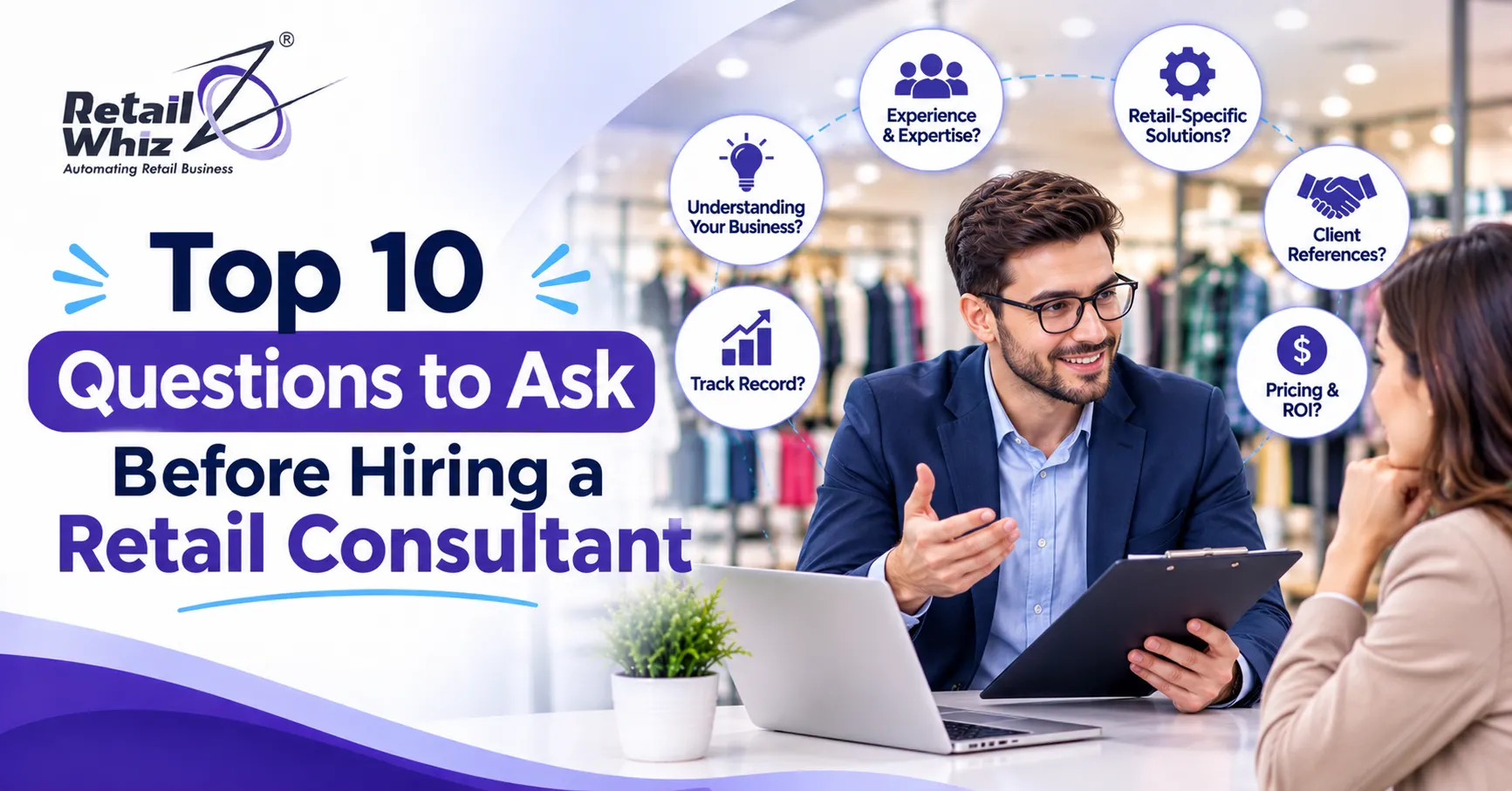
This guide covers the top 10 questions to ask before hiring a retail consultant. Use them to compare candidates, spot red flags, and make a confident decision.
Why It Pays to Vet a Retail Consultant Carefully
Retail consulting is not one-size-fits-all. A consultant who has scaled a luxury fashion brand may know little about running a high-volume supermarket, and a strategy expert may not understand the daily realities of billing, purchasing, and stock control.
Before you spend your budget, you need clarity on three things:
- Whether the consultant understands your retail format and market
- Whether their approach is practical and measurable
- Whether they will stay involved until results show up
The ten questions below are designed to uncover exactly that.
1. What Retail Experience Do You Have in My Specific Segment?
Start with relevance. Retail is a broad industry, and the challenges of a grocery chain differ sharply from those of a footwear store, a pharmacy, or a boutique.
Ask the consultant:
- Which retail formats have you worked with (supermarket, apparel, pharmacy, home décor, and so on)?
- Have you handled single stores, multi-store chains, or both?
- Do you understand the Indian retail market, including GST, local supplier networks, and regional buying behaviour?
A consultant with direct experience in your segment will diagnose problems faster and avoid generic advice. If you are looking for a partner with deep domain knowledge, you can explore retail consultancy services built around real store operations and not just theory.
2. Can You Share Case Studies and Verifiable References?
Anyone can claim success. Proof is what separates credible retail business consultants from the rest.
Request:
- Two or three case studies with clear before-and-after numbers
- Contact details of past clients you can call
- Examples of problems similar to yours that they have solved
Pay attention to the type of results they quote. Strong answers mention measurable outcomes such as reduced stock holding days, improved gross margin, faster checkout times, or higher repeat purchase rates. Vague claims like “we helped them grow” without numbers deserve follow-up questions.
3. How Will You Diagnose My Business Before Recommending Solutions?
A trustworthy retail consultant never hands out advice before understanding your business. The diagnosis phase is where the real value is created.
Ask them to walk you through their process. A solid audit usually covers:
- Store layout, visual merchandising, and customer flow
- Product assortment, pricing, and category performance
- Purchasing, replenishment, and supplier terms
- Staff productivity and training gaps
- Sales data, margins, and shrinkage
- The current technology stack, including billing and inventory tools
If a consultant promises a quick fix in the first meeting, treat it as a warning sign. Real retail strategy begins with data, store visits, and conversations with your team.
4. Which KPIs Will You Use to Measure Success?
Without clear metrics, you cannot judge whether the engagement is working. Before signing, agree on the key performance indicators that matter to your business.
Common retail KPIs include:
- Sales per square foot
- Gross margin return on inventory investment (GMROI)
- Inventory turnover and sell-through rate
- Average transaction value and units per transaction
- Customer retention and repeat purchase rate
- Shrinkage and stock variance
Ask how these will be tracked and reported. The best consultants rely on dashboards and regular reviews rather than opinions. If your current reporting is weak, ask whether they can recommend tools such as MIS and analytics that give you real-time visibility into sales, stock, and profitability.
5. What Is Your Approach to Inventory and Merchandise Planning?
Inventory is usually the largest investment in any retail business, and it is where many stores lose money without realising it. Overstocking ties up cash, while stockouts push customers to competitors.
Ask the consultant how they approach:
- Demand forecasting and seasonal planning
- Open-to-buy budgets and reorder levels
- Dead stock and slow-moving item clearance
- Supplier negotiations and purchase cycles
- Stock accuracy through cycle counts and audits
A capable retail consultant should be able to explain inventory control in simple terms and show how better planning translates into improved cash flow. This is also a good moment to ask how they handle category management and markdown strategy.
6. How Do You Approach Technology, Retail ERP Software, and POS Systems?
Modern retail runs on data. Whether you operate one store or fifty, your point of sale, inventory, purchasing, and accounting systems need to work together.
Ask the consultant:
- Are you technology-agnostic, or do you push specific products?
- Can you assess whether my current billing and inventory systems are holding me back?
- Do you have experience supporting software selection, rollout, and staff training?
- How do you handle data migration and integration with accounting tools?
The best retail consulting services combine strategy with practical execution, which means they understand how software changes daily operations. If your audit points to the need for a new system, working with a team that offers retail ERP implementation alongside consulting can save you from handing the project between multiple vendors.
7. Who Will Actually Work on My Project?
This question is often overlooked, yet it matters a great deal. In many firms, a senior expert wins the contract and a junior team delivers the work.
Clarify:
- Who will lead the engagement day to day?
- What is the experience level of the people assigned?
- How much time will they spend on-site, in your stores, and with your staff?
- Who is your point of contact if something goes wrong?
You are paying for expertise, so make sure the people you meet in the pitch are the people you will work with.
8. How Will You Involve My Team and Manage Change?
Even the best retail strategy fails if store managers and staff do not adopt it. Many consulting projects collapse during implementation because nobody prepared the team for new processes.
Ask how the consultant will:
- Communicate changes to store staff and managers
- Train employees on new procedures or systems
- Handle resistance from long-serving team members
- Make improvements stick after the engagement ends
Look for answers that include hands-on training, simple documentation, and follow-up reviews. A consultant who treats your people as partners usually delivers longer-lasting results.
9. What Is Your Pricing Model, and What Does It Include?
Retail consulting cost varies widely depending on scope, duration, and the consultant’s experience. Never choose purely on price, but do insist on complete transparency.
Ask for a written breakdown covering:
- Fee structure (fixed fee, monthly retainer, hourly, or performance-linked)
- Deliverables included in the price
- Travel, software, and other additional expenses
- Payment milestones tied to progress
- The cost of extensions or additional store visits
Also ask about the expected return. A good consultant will estimate how the engagement can pay for itself through higher margins, lower wastage, or better productivity. If the price seems unusually low, find out what has been left out. If it seems high, ask what extra value you are receiving.
10. What Happens After the Engagement Ends?
The final question is about sustainability. Many consultants disappear once the final report is delivered, leaving the business to figure out implementation alone.
Find out:
- Whether post-project support or review calls are included
- How progress will be monitored in the first three to six months
- What documentation and training material you will receive
- Whether they can help with ongoing software support, reporting, or process audits
A long-term partner will care about your results months after the contract ends, and that attitude tells you a lot about their credibility.
Red Flags to Watch Out For
While interviewing candidates, be cautious if you notice any of the following:
- Guaranteed results without reviewing your data
- No verifiable references or case studies
- A one-size-fits-all strategy presented as custom work
- Pressure to sign quickly or pay large amounts upfront
- Lack of interest in speaking with your store teams
- Reluctance to put scope, timelines, and fees in writing
Trust your instincts. If answers feel vague or rehearsed, keep looking.
How to Compare Retail Consultants Side by Side
Once you have spoken to two or three candidates, score each one on a simple scale of 1 to 5 across the following areas:
- Relevant retail experience
- Quality of case studies and references
- Depth of diagnostic process
- Technology and ERP understanding
- Clarity of KPIs and reporting
- Transparency of pricing
- Post-project support
Add up the scores and discuss the results with your leadership team. This structured approach reduces bias and keeps the decision focused on business value.
Final Thoughts
Hiring a retail consultant is a strategic decision, and the right partner can reshape your store performance, strengthen your operations, and help you scale with confidence. By asking these ten questions about experience, diagnosis, KPIs, inventory, technology, team involvement, pricing, and post-project support, you give yourself the best chance of choosing someone who delivers lasting results.
If you are also evaluating software as part of your retail transformation, our guide on the top 10 retail ERP software in India can help you compare your options before you commit.
Frequently Asked Questions (FAQs)
1. What does a retail consultant do?
A retail consultant studies your business and recommends practical improvements in areas such as store operations, merchandising, inventory management, pricing, staff productivity, customer experience, and technology. They typically conduct an audit, identify gaps, build an action plan, and support implementation.
2. When should I hire a retail consultant?
Consider hiring one when sales have stalled, margins are shrinking, stock levels are hard to control, you plan to open new stores, or you are about to adopt new retail software. An outside expert can also help during rapid growth, when processes need to scale.
3. How much does it cost to hire a retail consultant?
Costs depend on the scope of work, the size of your business, and the consultant’s experience. Some charge a fixed project fee, others a monthly retainer or hourly rate. Ask for a detailed written proposal and compare the expected return against the investment.
4. How long does a typical retail consulting engagement last?
A focused audit may take a few weeks, while a full transformation covering operations, technology, and training can run for several months. Agree on timelines and milestones in advance so that progress is easy to track.
5. Can a retail consultant help me choose the right retail software?
Yes. An experienced consultant can assess your current systems, define your requirements, shortlist suitable retail ERP and POS options, and guide implementation and staff training. Choose someone who stays objective and focuses on your business needs.