Every retail business runs on a simple truth: no products, no sales. Behind every shelf stocked with the right items at the right time sits a network of vendors, suppliers, and distributors working in sync with the store. When that network is managed well, retailers enjoy steady stock, better pricing, and fewer disruptions. When it is managed poorly, retailers face stockouts, delayed shipments, mismatched invoices, and strained supplier relationships.
This is where vendor management for retail business becomes critical. In this guide, we will break down what vendor management really means, why it matters for retailers of every size, the best practices that top-performing retail businesses follow, and how a modern vendor management software tool can simplify the entire process. If you run a supermarket, a pharmacy chain, an apparel store, or an FMCG outlet, this guide is built for you.
What Is Vendor Management in Retail?
Vendor management in retail refers to the process of identifying, onboarding, evaluating, and maintaining relationships with the suppliers who provide goods and services to a retail business. It covers everything from vendor selection and contract negotiation to purchase order creation, delivery tracking, invoice reconciliation, and performance reviews.
In simple terms, vendor management is about making sure your retail business always has the right products, from the right supplier, at the right price, delivered on time. It is a core part of retail operations management and directly affects inventory management, cash flow, and customer satisfaction.
Why Vendor Management Matters for Retail Businesses
Retail businesses often work with dozens or even hundreds of vendors across categories like groceries, apparel, electronics, and pharmaceuticals. Without a structured vendor management process, retailers face several risks:
- Inconsistent stock replenishment leading to stockouts or overstocking
- Price discrepancies and billing errors that hurt profit margins
- Poor visibility into vendor performance and delivery timelines
- Difficulty scaling operations across multiple stores or branches
- Compliance issues related to GST, tax invoices, and purchase documentation
Strong vendor management helps retail businesses build reliable supply chains, negotiate better trade terms, and maintain consistent product availability, which ultimately drives customer loyalty and repeat sales.
Common Vendor Management Challenges in Retail
Before jumping into best practices, it helps to understand the everyday challenges retailers face when managing vendors manually:
Manual purchase order processes
Many small and mid-sized retailers still create purchase orders on paper or spreadsheets. This increases the risk of errors and slows down the entire procurement cycle.
Lack of centralized vendor data
When vendor contact details, contracts, pricing agreements, and payment terms are scattered across emails and files, retailers lose time searching for basic information.
Delayed goods receipt and invoice mismatches
Without a system to match purchase orders against goods received and vendor invoices, retailers often overpay or face billing disputes.
No visibility into vendor performance
Retailers rarely track metrics like on-time delivery rate, order accuracy, or return rate, which makes it hard to decide which vendors deserve more business and which ones need to be replaced.
Difficulty managing multiple locations
For retail chains with several branches or warehouses, coordinating vendor deliveries and stock transfers without a centralized retail ERP software becomes a logistical challenge.
Vendor Management Best Practices for Retail Business
1. Centralize Vendor Information
Keep all vendor details, including contact information, GST numbers, pricing agreements, credit terms, and past order history, in a single centralized database. This eliminates confusion and speeds up decision-making during procurement.
2. Standardize the Vendor Onboarding Process
Create a clear onboarding checklist for new vendors that includes document verification, pricing negotiation, quality benchmarks, and delivery expectations. A standardized process reduces onboarding time and ensures consistency across your vendor base.
3. Automate Purchase Orders and Approvals
Manual purchase order creation is one of the biggest bottlenecks in retail procurement. Automating this process through retail software ensures purchase orders are generated based on real stock levels, reducing both overstocking and understocking.
4. Set Clear Vendor Performance Metrics
Track key performance indicators such as on-time delivery percentage, order fulfillment accuracy, product quality, and pricing consistency. Reviewing these metrics quarterly helps retailers decide which vendors to retain, renegotiate with, or replace.
5. Maintain Transparent Communication Channels
Delays and disputes often happen because of poor communication. Use a shared platform where vendors can view purchase orders, delivery schedules, and payment status in real time. This builds trust and reduces back-and-forth emails or calls.
6. Reconcile Invoices Against Purchase Orders and GRNs
Every invoice received from a vendor should be matched against the original purchase order and the goods received note (GRN). This three-way matching process prevents overbilling and keeps your accounts payable accurate.
7. Diversify Your Vendor Base
Relying on a single supplier for a critical product category is risky. Retailers should maintain relationships with at least two or three vendors per category to avoid disruptions during shortages, price hikes, or delivery delays.
8. Negotiate and Document Payment Terms Clearly
Ambiguous payment terms lead to disputes. Document credit periods, early payment discounts, and penalty clauses clearly in vendor contracts, and store these agreements digitally for quick reference.
9. Review Vendor Contracts Regularly
Market prices, transportation costs, and demand patterns change over time. Reviewing vendor contracts every six to twelve months ensures your retail business is always getting competitive pricing and updated service terms.
10. Use Data to Forecast Vendor Requirements
Analyzing past sales and seasonal demand patterns helps retailers plan vendor orders in advance, especially during festive seasons or promotional periods, avoiding last-minute stock shortages.
How Vendor Management Software Helps Retail Businesses
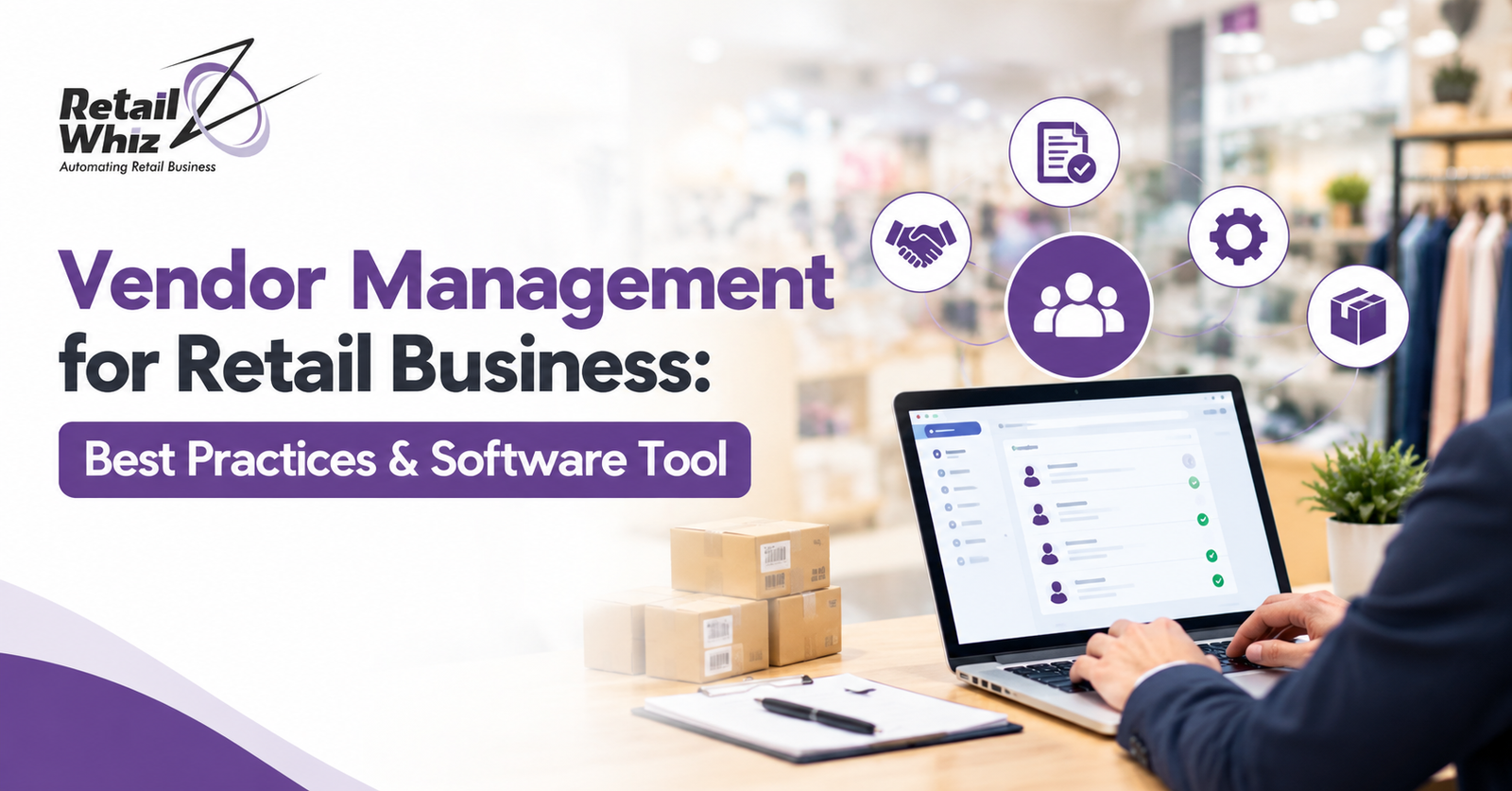
Manually managing vendors becomes unsustainable as a retail business grows across categories and locations. This is where dedicated vendor management software, integrated within a retail ERP system, makes a significant difference.
A good vendor management software tool allows retailers to:
- Maintain a centralized vendor database with contracts, pricing, and communication history
- Generate purchase orders automatically based on real-time stock and sales data
- Track goods receipt and match invoices instantly to avoid billing errors
- Monitor vendor performance through dashboards and reports
- Manage multiple vendors across multiple store locations from a single platform
- Simplify GST-compliant invoicing and tax reporting for procurement
By combining vendor management with inventory management and point-of-sale data, retailers get a complete, real-time view of their supply chain. This kind of integrated approach is exactly what a robust retail ERP software is designed to deliver, connecting procurement, billing, and stock control under one system.
Key Features to Look for in Vendor Management Software
When evaluating vendor management software for your retail business, look for these essential features:
Centralized vendor database
A single place to store vendor profiles, agreements, and communication logs.
Automated purchase order generation
The ability to trigger purchase orders based on minimum stock levels or sales forecasts.
Three-way invoice matching
Automatic matching of purchase orders, goods received notes, and vendor invoices to reduce billing disputes.
Vendor performance analytics
Dashboards that show delivery timelines, order accuracy, and pricing trends over time.
Multi-location support
Support for managing vendors and stock transfers across multiple stores, warehouses, or branches.
GST and tax compliance
Built-in support for GST invoicing, e-way bills, and tax reporting relevant to Indian retail businesses.
Integration with inventory and accounting
Seamless data flow between procurement, inventory management, and financial accounting to avoid duplicate data entry.
If your retail business is transitioning from spreadsheets or an older billing system, moving historical vendor, purchase, and pricing records safely into a new platform matters just as much as choosing the right software. RetailWhizz’s retail data migration services help retailers transfer vendor masters, purchase history, and pricing structures accurately, so you do not lose critical procurement data during the switch.
Manual Vendor Management vs Software-Driven Vendor Management
| Aspect | Manual Process | Vendor Management Software |
| Purchase order creation | Time-consuming, error-prone | Automated and accurate |
| Vendor data access | Scattered across files and emails | Centralized and searchable |
| Invoice reconciliation | Manual matching, higher error rate | Automated three-way matching |
| Vendor performance tracking | Rarely tracked consistently | Real-time dashboards and reports |
| Scalability across locations | Difficult to manage | Easily scalable |
The shift from manual to software-driven vendor management is one of the highest-impact upgrades a growing retail business can make, both for operational efficiency and for long-term cost savings.
Choosing the Right Vendor Management Software for Your Retail Business
Not every retail business needs the same level of complexity. A single-store apparel shop and a 30-branch supermarket chain will have very different requirements. When selecting vendor management software, consider:
- Whether it integrates with your existing POS and inventory management system
- Whether it supports your retail vertical, such as grocery, pharmacy, apparel, or FMCG
- Whether it can scale as you add new stores or warehouses
- Whether it offers GST-compliant billing and reporting out of the box
- The quality of vendor support and onboarding assistance provided by the software company
Retailers who have used ERP-based vendor and inventory management systems for years typically report smoother store operations, fewer stockouts, and better supplier negotiations because they finally have accurate, real-time data at hand.
Conclusion
Vendor management for retail business is not just an administrative task. It is a strategic function that directly affects inventory accuracy, cash flow, and customer satisfaction. By adopting best practices such as centralizing vendor data, automating purchase orders, tracking vendor performance, and reviewing contracts regularly, retailers can build a resilient and cost-efficient supply chain.
Pairing these best practices with the right vendor management software, ideally one integrated into a complete retail ERP platform, gives retail businesses the visibility and control needed to grow confidently, whether you operate one store or a chain of fifty.
Frequently Asked Questions
1. What is vendor management in retail business?
Vendor management in retail business is the process of selecting, onboarding, evaluating, and maintaining relationships with suppliers who provide goods to a retail store. It includes purchase order creation, delivery tracking, invoice reconciliation, and vendor performance reviews.
2. Why is vendor management software important for retailers?
Vendor management software automates purchase orders, centralizes vendor data, and matches invoices against deliveries, reducing manual errors and helping retailers maintain consistent stock levels and better supplier relationships.
3. What are the key best practices for vendor management in retail?
Key best practices include centralizing vendor information, automating purchase orders, setting clear performance metrics, diversifying your vendor base, and reviewing contracts regularly to ensure competitive pricing and reliable service.
4. How does vendor management improve inventory management?
Effective vendor management ensures timely restocking based on real demand, reducing both overstocking and stockouts. When integrated with inventory management systems, it gives retailers real-time visibility into stock levels and incoming orders.
5. Can small retail businesses benefit from vendor management software?
Yes, small retail businesses benefit significantly since automated purchase orders and centralized vendor records save time, reduce billing errors, and support better negotiation with suppliers, even with a limited number of vendors.