Running a retail business today means juggling sales, stock, staff, taxes, and customer expectations, often all at once. Without the right accounting software, this juggling act turns into late nights of manual entry, missed GST deadlines, and inventory numbers that never quite match reality.
The good news is that accounting software for retailers has come a long way. Today’s tools do far more than record income and expenses. They handle GST invoicing, real time inventory tracking, multi-store reporting, and even connect directly with your point of sale system so every sale updates your books automatically.
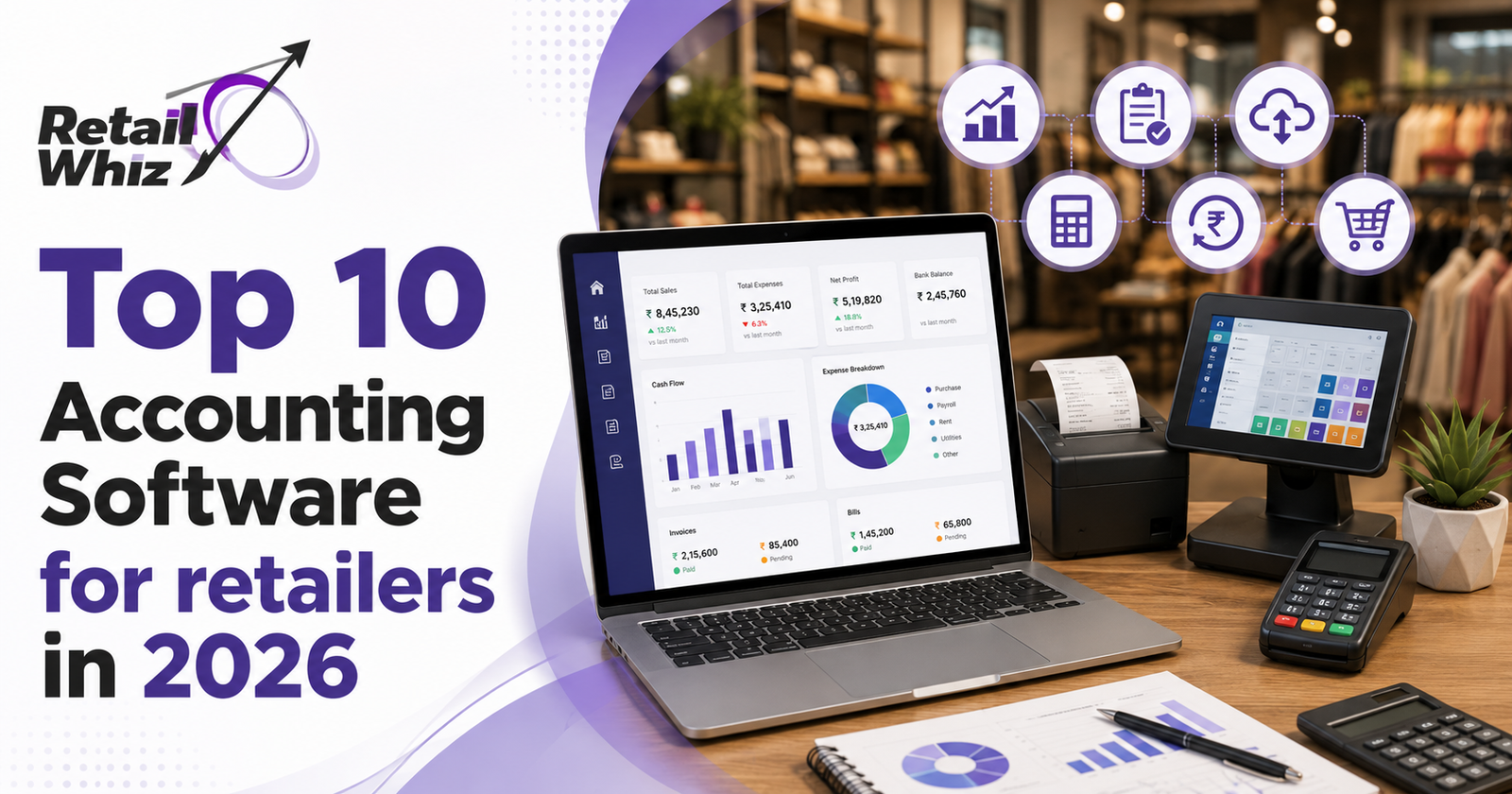
In this blog, we will walk through the top 10 accounting software for retailers in 2026, comparing features, pricing, and who each tool is best suited for, so you can choose the right fit for your store.
Why Retailers Need Specialized Accounting Software in 2026
Generic bookkeeping tools are not built for the daily realities of retail. Retailers deal with challenges that most other businesses do not, including:
- High transaction volumes at the point of sale every single day
- Frequent stock movement that needs to reflect accurately in cost of goods sold
- GST invoicing, e-way bills, and HSN-wise reporting requirements
- Multiple store locations or sales channels that need consolidated reporting
- Seasonal demand that affects cash flow and purchase planning
A retail-focused accounting solution solves these problems by connecting billing, inventory, and accounting into one system rather than forcing you to reconcile three separate tools manually. This is exactly the gap that a good GST billing software solution is designed to close for growing retail stores in India.
Top 10 Accounting Software for Retailers in 2026
1. RetailWhizz
RetailWhizz is built specifically for retail businesses that need billing, inventory, and accounting working together rather than as separate add-ons. It automatically generates GST compliant invoices, updates stock in real time with every sale, and gives store owners a single dashboard to track revenue, expenses, and margins across single or multiple outlets. For retailers who want their point of sale and accounting fully connected without stitching together third-party integrations, RetailWhizz is a strong starting point.
Best for: Retail stores that want billing, inventory, and accounting unified in one platform.
2. TallyPrime
TallyPrime remains one of the most trusted names in Indian accounting software, particularly for GST compliance. Every sales entry feeds directly into GSTR-1 and GSTR-3B reports, and the software flags missing HSN codes or incorrect tax rates before filing. Retailers with multiple GSTIN registrations can manage them from a single company file, which is useful for multi-branch operations.
Best for: Small to mid-sized retailers who need deep GST compliance and are comfortable with a traditional, desktop-first workflow.
3. Zoho Books
Zoho Books is a cloud based accounting platform that works well for retailers who want automation without a steep learning curve. It offers automatic bank feeds, GST-ready invoicing, inventory tracking, and a clean dashboard that non-accountants can navigate easily. Its integration ecosystem also connects with various POS and e-commerce platforms, making it a solid choice for omnichannel sellers.
Best for: Retailers who want an easy to use, cloud based system with strong automation.
4. Vyapar
Vyapar is a mobile-first billing and accounting app designed with small shop owners in mind. It supports GST invoicing, barcode based billing, payment tracking, and basic inventory management, all from a smartphone. Its simplicity makes it especially popular among kirana stores and single-location retail shops that need quick billing without complex setup.
Best for: Small retail shop owners who want fast billing and accounting on mobile.
5. myBillBook
myBillBook focuses on retail shops that need multi-device access without sacrificing simplicity. It allows business owners to create GST invoices, track inventory, manage staff access, and view sales reports from both web and mobile apps. The interface is designed for retailers with limited accounting background, making onboarding fast.
Best for: Retail shops needing consistent access across multiple devices and staff members.
6. Busy Accounting Software
Busy Accounting Software combines GST compliance, inventory management, and financial reporting in a package aimed at SMEs, including retailers, distributors, and traders. It supports e-invoicing, e-way bill generation, GSTR-2B reconciliation, and multi-branch inventory tracking, making it suitable for retailers who are scaling beyond a single store.
Best for: Growing retail businesses that need robust compliance and multi-branch inventory support.
7. Marg ERP 9+
Marg ERP 9+ has a strong reputation among pharmacy, FMCG, and general retail businesses that deal with large product catalogs and batch or expiry tracking. It handles GST billing, purchase and sales order management, and integrates with accounting for a complete retail workflow. Retailers dealing with perishable or expiry-sensitive stock often find this tool particularly useful.
Best for: Retailers managing large inventories with batch numbers or expiry dates, such as pharmacies and grocery stores.
8. QuickBooks Online
QuickBooks Online is widely used by retailers who also sell online, thanks to its strong integrations with platforms like Shopify and various payment processors. It handles inventory valuation, cost of goods sold tracking, and produces clean financial reports that are useful for lenders and investors. For retailers running both a physical store and an online storefront, QuickBooks Online offers dependable multi-channel reconciliation.
Best for: Retailers operating both brick-and-mortar and online stores who need reliable multi-channel accounting.
9. ClearTax
ClearTax started as a tax filing platform and has expanded into a broader accounting and compliance solution. It is particularly strong for retailers who want GST return filing, e-invoicing, and reconciliation handled with minimal manual effort. Businesses that prioritize tax accuracy and want expert support during filing season often prefer ClearTax.
Best for: Retailers who want strong GST filing support alongside basic accounting features.
10. Refrens
Refrens is a cloud based invoicing and accounting tool that has gained traction among small and mid-sized retail businesses. It offers GST-ready invoices, inventory tracking, an AI-assisted accounting workflow, and role-based access for teams. Its simplicity combined with automation features makes it a practical option for retailers who are moving away from spreadsheets for the first time.
Best for: Retailers transitioning from manual bookkeeping to a structured, cloud based accounting system.
How to Choose the Right Accounting Software for Your Retail Store
With so many options available, narrowing down the right choice comes down to a few key questions.
How many locations do you operate? Single-store retailers can often manage with simpler, mobile-first tools, while multi-store businesses need software with consolidated, branch-level reporting.
Do you sell online as well as in-store? If you run an omnichannel operation, prioritize software that reconciles sales across both channels without manual re-entry.
How complex is your inventory? Retailers dealing with batch numbers, expiry dates, or large SKU counts need software built for detailed inventory tracking, not just basic stock counts.
Does it integrate with your POS system? This is one of the most important factors. Manually transferring sales data from your point of sale to your accounting software wastes time and increases the risk of errors. Our guide on how to choose the right billing software for your retail store breaks down exactly what to look for in a connected billing and accounting setup.
What is your budget and team size? Some tools charge per user, while others offer flat pricing regardless of team size. Match this to how many staff members actually need system access.
The Role of POS Integration in Retail Accounting
One theme runs through nearly every accounting software comparison for retailers in 2026: the software is only as useful as the data flowing into it. If your point of sale system and your accounting software are not connected, you end up manually re-entering daily sales totals, which increases the chance of mismatched books and delayed GST filing.
This is why more retailers are choosing platforms where billing, inventory, and accounting operate as one system rather than three disconnected tools. A well integrated POS software solution ensures every transaction at the counter is automatically reflected in your financial reports, without any manual reconciliation at the end of the day.
Accounting Software vs Full Retail ERP
For retailers that are scaling quickly, it is worth understanding the difference between standalone accounting software and a full retail ERP system. Accounting software focuses primarily on financial records, invoicing, and tax compliance. A retail ERP, on the other hand, combines accounting with inventory, procurement, staff management, and multi-store operations under one system. If you are unsure which path fits your business stage, our comparison on retail ERP vs POS software explains when it makes sense to upgrade from basic accounting tools to a complete retail management system.
Final Thoughts
The best accounting software for retailers in 2026 is not necessarily the one with the longest feature list, but the one that fits how your store actually operates. If you run a single shop, a mobile-first tool like Vyapar or myBillBook might be all you need. If you are managing multiple locations or selling across online and offline channels, a more robust platform like Zoho Books, QuickBooks Online, or an integrated solution like RetailWhizz will save far more time in the long run.
Whatever stage your business is at, the goal remains the same: accurate books, faster GST compliance, and clear visibility into how your store is actually performing, without hours of manual data entry standing in the way.
Frequently Asked Questions (FAQs)
1. What is the best accounting software for small retail shops in India?
For small retail shops, mobile-first tools like Vyapar and myBillBook are popular choices because they offer GST billing, inventory tracking, and easy invoicing without a steep learning curve.
2. Do retailers need separate billing and accounting software?
Not necessarily. Many modern solutions, including RetailWhizz, combine billing, inventory, and accounting in one platform, which reduces manual data entry and keeps financial records accurate in real time.
3. Which accounting software is best for multi-store retail chains?
Retailers operating multiple locations often prefer tools like Busy Accounting Software, TallyPrime, or QuickBooks Online, since they support consolidated, branch-level financial reporting.
4. Is GST compliance included in retail accounting software?
Most accounting software built for the Indian market, including TallyPrime, Vyapar, Zoho Books, and ClearTax, includes GST invoicing, e-way bill generation, and return filing support as standard features.
5. How important is POS integration when choosing accounting software?
It is one of the most important factors. Software that connects directly with your point of sale system automatically updates inventory and financial records with every sale, reducing errors and saving significant time compared to manual entry.