Every retailer has lived through both nightmares. Shelves sitting empty on a Saturday afternoon while customers walk out empty handed. Or a storeroom stacked with slow moving stock that ties up cash and eventually gets marked down or written off. Both problems trace back to the same root cause: poor demand prediction.
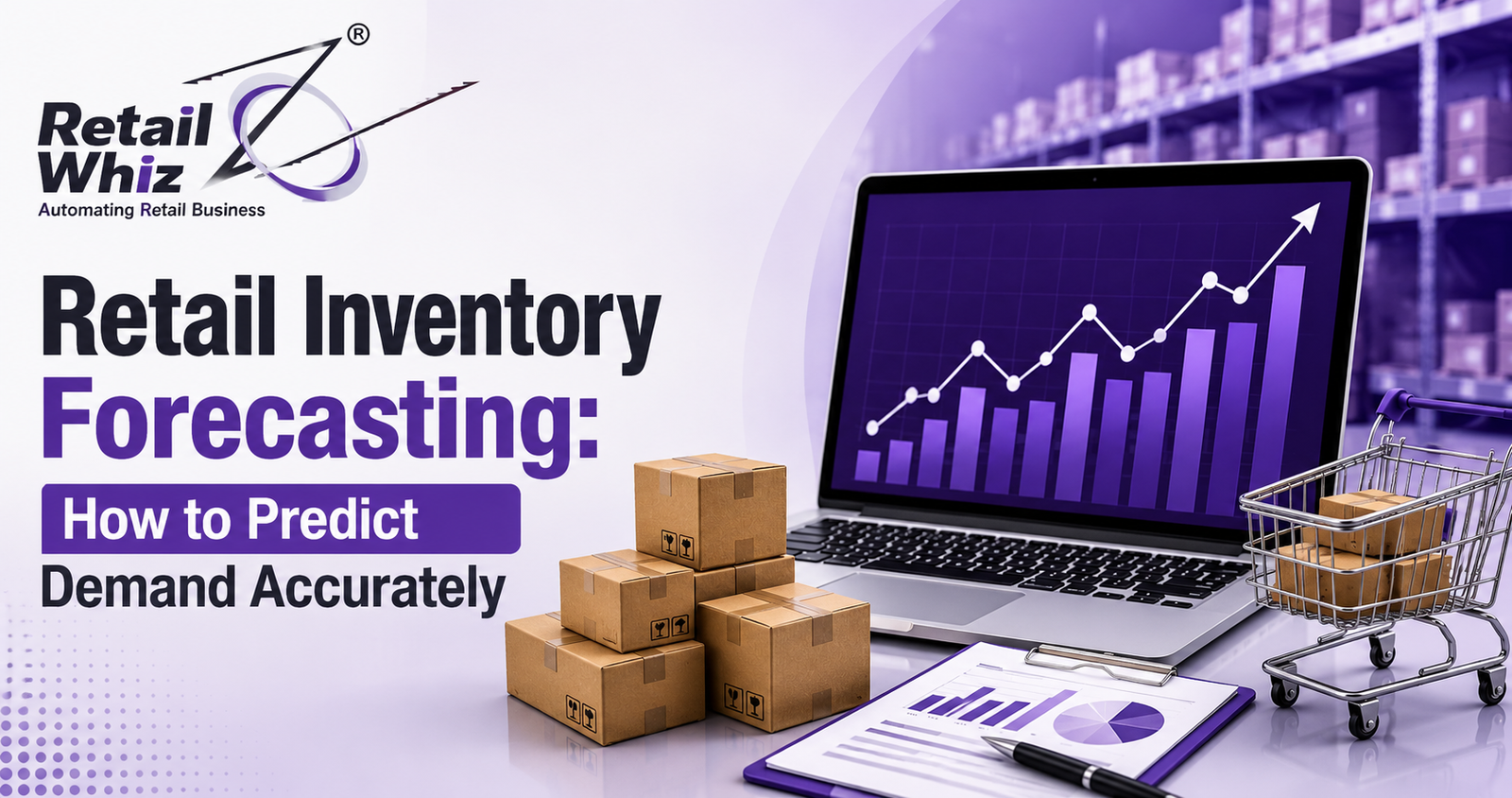
Retail inventory forecasting is the process of using historical sales data, market trends, and seasonal patterns to estimate how much of each product you will sell in a given period. Done well, it is the difference between a store that runs lean and profitable and one that constantly firefights stockouts, overstock, and cash flow problems.
In this guide, we will break down what retail inventory forecasting actually means, why accurate demand forecasting matters more than ever, the methods retailers use to predict demand, common mistakes that throw off forecasts, and practical steps to build a forecasting process that actually works for your store.
What Is Retail Inventory Forecasting?
Retail inventory forecasting, also called demand forecasting or demand planning, is the practice of predicting future customer demand for products so you can plan purchasing, stocking, and replenishment accordingly. It answers a simple but critical question: how much of this product will I need, and when will I need it?
A good forecast looks at multiple data points together, including:
- Historical sales data by SKU, category, and location
- Seasonal buying patterns and festival demand spikes
- Promotional calendars and discount cycles
- Local events, weather patterns, and economic conditions
- Supplier lead times and reorder cycles
- New product launches and discontinued lines
The goal is not a perfect prediction. No forecast is ever 100 percent accurate. The goal is to get close enough, consistently enough, that you can make confident purchasing decisions instead of guessing.
Why Accurate Demand Forecasting Matters
Retailers who treat inventory forecasting as a guessing game usually pay for it in one of two ways.
Stockouts cost you sales and loyalty. When a customer cannot find what they came for, they do not always wait. Many simply buy from a competitor, and repeated stockouts quietly erode trust in your store.
Overstocking ties up working capital. Excess inventory sits on shelves or in the backroom, consuming storage space and cash that could be used elsewhere in the business. For perishable categories like grocery, dairy, and FMCG, overstocking also means direct losses from spoilage and expiry.
Accurate demand forecasting directly improves:
- Cash flow, by avoiding capital getting locked in slow moving stock
- Customer satisfaction, by keeping popular items consistently available
- Supplier negotiations, since predictable order volumes strengthen your buying position
- Operational efficiency, by reducing emergency reorders and rush shipping costs
- Profit margins, by minimizing markdowns, shrinkage, and dead stock
For multi-store retailers, the stakes are even higher. A forecast that ignores store-level demand differences can lead to one outlet running out of stock while another sits on excess inventory of the same item. This is where a centralized retail inventory management software becomes valuable, since it gives you real-time visibility across every location instead of relying on isolated spreadsheets.
Common Methods Used to Predict Demand
There is no single correct way to forecast demand. Most retailers combine a few of these approaches depending on their business size and product mix.
1. Historical Sales Analysis
The simplest and most widely used method. You look at past sales data over weeks, months, or years to identify patterns, then project those patterns forward. This works well for stable, non-seasonal products but struggles with new launches or products affected by external shocks.
2. Moving Average Forecasting
This smooths out short-term fluctuations by averaging sales over a rolling period, such as the last 4 or 12 weeks. It reduces the noise from one-off spikes or dips and gives a clearer trend line to plan around.
3. Seasonal Index Forecasting
Many retail categories, from apparel to festive gifting to grocery staples, follow predictable seasonal cycles. Seasonal index forecasting assigns a multiplier to each period based on historical seasonal behavior, helping you stock up ahead of festivals, summer, or back-to-school demand instead of reacting after the rush begins.
4. Qualitative and Market-Based Forecasting
For new product launches or categories with no sales history, forecasts often rely on market research, competitor benchmarking, supplier insight, and staff input from the sales floor. This is less precise but essential when historical data simply does not exist.
5. Software-Driven Predictive Forecasting
Modern retail forecasting increasingly relies on software that automatically analyzes sales velocity, seasonality, and stock movement across categories and locations, then generates reorder recommendations. This removes much of the manual guesswork and scales far better than spreadsheet-based forecasting, especially for retailers managing thousands of SKUs.
Common Forecasting Mistakes Retailers Make
Even experienced retailers fall into predictable traps when forecasting demand.
- Relying on gut feel instead of data. Experience matters, but intuition alone cannot account for shifting customer behavior or market trends.
- Ignoring seasonality and local events. A forecast built purely on last month’s sales will miss festival spikes, weather-driven demand, or local events that shift buying patterns.
- Treating all stores the same. Demand at a high-footfall city outlet looks nothing like demand at a smaller neighborhood store. Applying one blanket forecast across locations almost guarantees imbalance.
- Not accounting for promotions. A discount or bundle offer can spike demand temporarily. If this spike gets baked into your baseline forecast, you risk overordering once the promotion ends.
- Forecasting too infrequently. Demand shifts constantly. Reviewing forecasts once a quarter is rarely enough for fast-moving categories like grocery or fashion.
- Working from disconnected systems. When your billing, purchase, and stock data live in separate tools, forecasting becomes a manual, error-prone exercise instead of a real-time process.
How to Build a Reliable Inventory Forecasting Process
Building accuracy into your forecasting does not require a complete overhaul overnight. A structured, phased approach works best.
Start with clean, centralized data. Forecasting is only as good as the data behind it. Make sure your sales, purchase, and stock data are captured accurately at the point of transaction rather than reconstructed later from memory or paper records. This is where a connected POS software for retail stores matters, since every bill generated feeds directly into your inventory and sales history instead of sitting in disconnected registers.
Segment your products. Not every SKU needs the same forecasting rigor. Classify products by sales velocity and margin contribution, then apply tighter forecasting and safety stock rules to your fastest-moving, highest-value items first.
Build in seasonality and promotions. Layer your historical baseline with known seasonal patterns and planned promotional calendars so spikes are anticipated rather than reacted to after the fact.
Review and adjust regularly. Set a cadence, weekly for fast-moving categories and monthly for slower ones, to compare actual sales against your forecast and recalibrate.
Track the right metrics. Metrics like forecast accuracy percentage, stockout rate, sell-through rate, and inventory turnover tell you whether your forecasting process is actually working or just producing numbers. A strong MIS and analytics solution makes these metrics visible in real time instead of buried in month-end reports.
Coordinate forecasting with your supply chain. A forecast is only useful if your purchasing and replenishment process can act on it quickly. Supplier lead times, reorder points, and delivery schedules all need to align with your predicted demand curves, which is where an integrated supply chain management software for retail helps close the loop between prediction and execution.
The Role of Technology in Modern Demand Forecasting
Spreadsheets served retailers well for decades, but they were never built to handle thousands of SKUs across multiple stores, dynamic promotions, and daily sales velocity changes. Manual forecasting is slow, error-prone, and reactive rather than predictive.
Retail-focused ERP and inventory platforms solve this by pulling sales, purchase, and stock data into one system automatically. Instead of a manager manually calculating reorder quantities every week, the system flags fast-moving SKUs approaching stockout, highlights slow-moving inventory before it becomes dead stock, and generates purchase suggestions based on actual demand trends rather than assumptions.
For growing retail chains, this shift from manual to software-driven forecasting is often the single biggest lever for improving both customer experience and profitability at the same time.
Final Thoughts
Retail inventory forecasting is not a one-time project. It is an ongoing discipline that blends historical data, seasonal awareness, and the right technology to keep your shelves stocked with exactly what customers want, when they want it. Retailers who invest in accurate demand forecasting consistently see fewer stockouts, less dead stock, healthier cash flow, and stronger customer loyalty.
Whether you run a single store or a growing multi-outlet chain, building a structured, data-driven forecasting process is one of the most reliable ways to protect your margins and scale confidently.
Frequently Asked Questions
1. What is the difference between inventory forecasting and demand forecasting?
They are closely related and often used interchangeably. Demand forecasting predicts how much customers will buy, while inventory forecasting translates that demand prediction into actual stock and purchase order quantities, factoring in lead times, safety stock, and storage capacity.
2. How often should retailers update their demand forecasts?
It depends on the category. Fast-moving goods like grocery and FMCG benefit from weekly forecast reviews, while slower-moving categories such as durables or apparel can often be reviewed monthly. Seasonal categories should be reviewed more frequently in the lead-up to peak periods.
3. What data do I need to start forecasting demand accurately?
At a minimum, you need historical sales data by SKU and location, current stock levels, supplier lead times, and a record of past promotions or seasonal events. The more consistent and centralized this data is, the more accurate your forecasts will be.
4. Can small retailers forecast demand without expensive software?
Yes, small retailers can start with basic methods like moving averages and seasonal indexing using spreadsheets. However, as SKU count and store count grow, manual forecasting becomes time-consuming and error-prone, which is when dedicated inventory management software starts to pay for itself.
5. How does accurate forecasting reduce retail costs?
Accurate forecasting reduces costs by minimizing emergency reorders, rush shipping, markdowns on excess stock, and losses from spoilage or expiry. It also frees up working capital that would otherwise be locked in unsold inventory, which can be redirected toward growth.