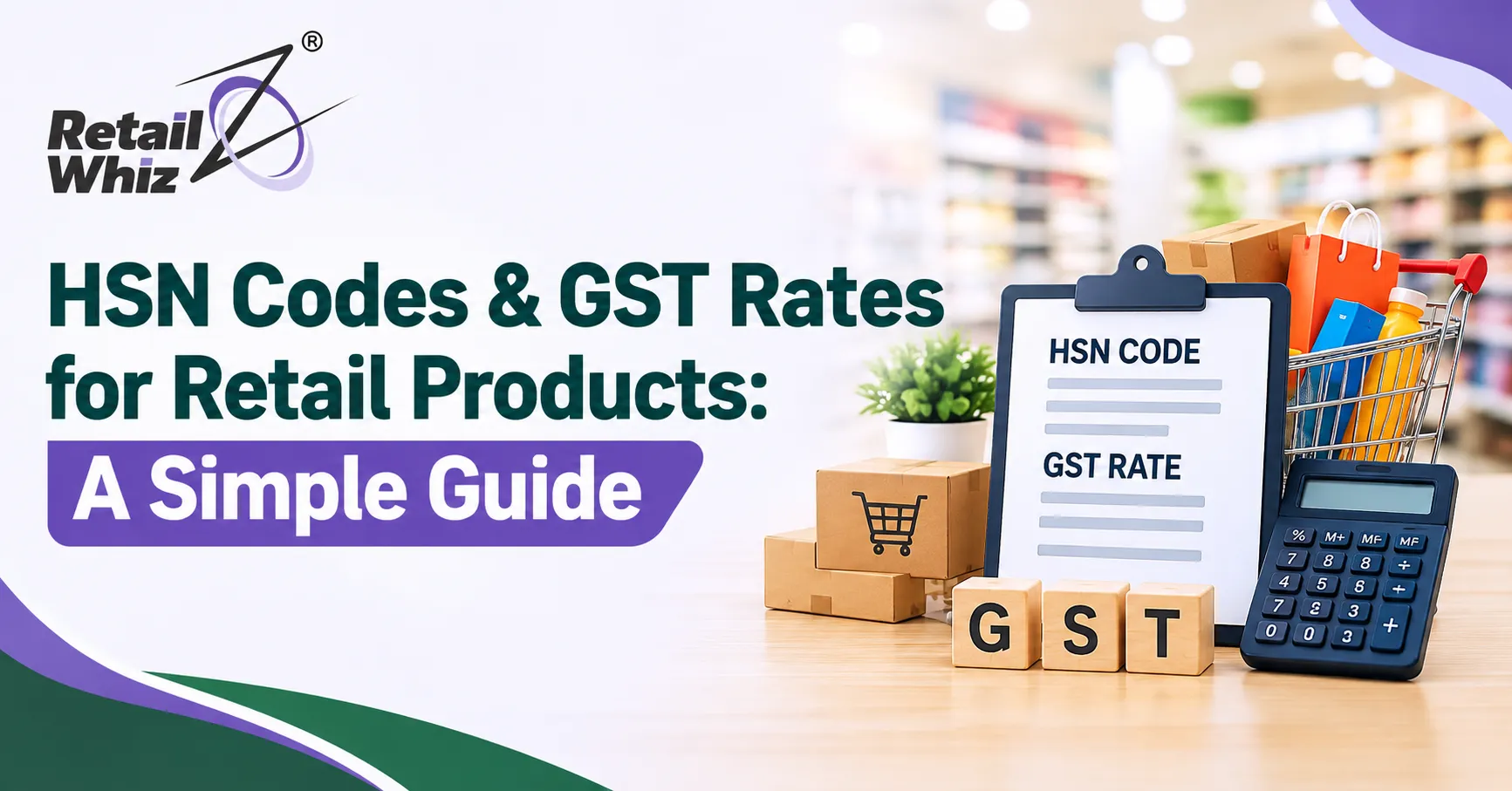
If you run a retail store in India, chances are you have come across the terms HSN code and GST rate more times than you can count. Whether you are billing a customer, filing a GST return, or updating your product catalog, these two elements decide how your invoice looks and how much tax you collect. Yet, many small and medium retailers still find HSN codes and GST rates confusing.
This guide breaks down everything you need to know about HSN codes for retail products and GST rates in India, in simple, practical language. No jargon, no complicated tax terms, just clear answers to help you run your retail business smoothly and stay compliant.
What Is an HSN Code?
HSN stands for Harmonized System of Nomenclature. It is an internationally accepted system for classifying goods, developed by the World Customs Organization. India adopted the HSN code system to standardize the classification of products under GST, making tax calculation, invoicing, and reporting more consistent across the country.
Every product you sell in your retail store, from groceries to garments to electronics, falls under a specific HSN code. This code is not random. It is a structured numeric code that groups similar products together so that businesses, tax authorities, and customs departments speak the same classification language.
How Is the HSN Code Structured?
The HSN code is typically a 4, 6, or 8-digit number, and the number of digits required depends on your business turnover.
- Chapter (first 2 digits): Represents the broad category of goods. For example, Chapter 61 covers knitted garments.
- Heading (next 2 digits): Narrows down the product group within that chapter.
- Sub-heading (next 2 digits): Further classifies the product type.
- Tariff item (last 2 digits): Used for even more specific classification, mainly for customs and export purposes.
For retail businesses, understanding this structure helps you find the correct HSN code for retail products quickly, whether you sell apparel, footwear, packaged food, cosmetics, or home appliances.
Who Needs to Mention HSN Codes on Invoices?
Under current GST rules, the requirement to mention HSN codes on invoices depends on your annual turnover.
- Businesses with turnover up to Rs. 5 crore in the previous financial year must mention a 4-digit HSN code on B2B invoices, and it is optional for B2C invoices.
- Businesses with turnover above Rs. 5 crore must mention a 6-digit HSN code on all invoices, both B2B and B2C.
This is where having reliable GST billing software becomes valuable for retailers. Instead of manually looking up HSN codes for every product category, a good billing system auto-fills the correct code and applicable GST rate at the time of sale, reducing errors and saving time during return filing.
Understanding GST Rates for Retail Products
GST in India follows a multi-tier rate structure, generally categorized under 0%, 5%, 12%, 18%, and 28% slabs, along with a few special rates for specific goods. As a retailer, the GST rate that applies to your product depends entirely on its HSN classification.
Here is a general breakdown of how GST rates typically apply to common retail categories:
0% GST (Exempt Category)
Items like fresh fruits, vegetables, unbranded food grains, and certain unprocessed agricultural products usually fall under this category. These attract no GST at all.
5% GST Slab
This slab generally covers essential items such as packaged food products, footwear priced below a certain threshold, certain textiles, and edible oils. Many everyday retail staples fall here.
12% GST Slab
Products like processed food items, certain apparel above a specified price point, and some household goods often fall into this middle slab.
18% GST Slab
This is one of the most common slabs for retail products, covering categories like cosmetics, electronics accessories, furniture, footwear above certain price limits, and many branded consumer goods.
28% GST Slab
Luxury and sin goods, along with select consumer durables like air conditioners and certain automobiles, attract this highest slab.
Because GST rates for retail products are frequently reviewed and revised by the GST Council, it is important to verify current rates before finalizing your product pricing, especially during seasonal sales or new product launches.
Why Accurate HSN and GST Classification Matters for Retailers
Getting your HSN codes and GST rates right is not just about compliance. It directly affects your business in several practical ways.
1. Accurate Invoicing
Incorrect HSN codes can lead to wrong tax calculation on invoices, which creates mismatches during GST return filing and can trigger notices from tax authorities.
2. Input Tax Credit Claims
If your purchase invoices carry incorrect HSN codes, it can complicate your input tax credit reconciliation, potentially delaying credit claims or leading to rejections.
3. Smooth GST Return Filing
GSTR-1 and other returns require HSN-wise summary reporting. Wrong classification means your returns will not match your actual sales, leading to unnecessary corrections and compliance headaches.
4. Avoiding Penalties
Misclassification of goods, whether intentional or accidental, can attract penalties during GST audits. Consistent, correct HSN mapping protects your retail business from compliance risks.
Common Challenges Retailers Face with HSN Codes and GST Rates
Many small retail businesses struggle with HSN and GST classification because of a few recurring issues:
- Wide product range: A retail store selling groceries, cosmetics, and household items has to track HSN codes across dozens of categories, each with a different GST rate.
- Frequent rate revisions: GST rates for retail products change periodically based on government notifications, and manually tracking every update is time-consuming.
- Manual billing errors: Retailers using manual billing or outdated systems often apply the wrong GST rate simply because staff are not updated on the latest HSN mapping.
- Multi-branch inconsistency: For retail chains with multiple outlets, ensuring every branch applies the same HSN code and GST rate for identical products can be difficult without centralized systems.
This is exactly why more retailers are shifting to automated billing and inventory systems. A well-configured retail POS software can store HSN codes against every SKU in your inventory, apply the correct GST rate automatically at billing, and generate GST-compliant invoices without manual intervention, even across multiple store locations.
How to Find the Correct HSN Code for Your Products
If you are setting up your product catalog and need to identify the right HSN codes for retail products, here are a few practical steps:
- Check the official GST portal: The GST portal provides an HSN code search tool where you can look up codes by product description.
- Refer to your supplier invoices: Manufacturers and wholesalers usually mention the HSN code on their invoices, which you can cross-verify and use.
- Consult your GST practitioner: For products with ambiguous classification, a tax consultant can help confirm the correct code.
- Use billing software with built-in HSN libraries: Modern retail billing tools come pre-loaded with HSN code databases mapped to common product categories, making classification faster and more accurate.
Tips to Stay GST Compliant as a Retailer
- Regularly review GST Council notifications for rate changes affecting your product categories.
- Maintain a master product list with HSN codes and applicable GST rates updated in your billing system.
- Train your billing staff to recognize when a new product needs HSN classification before it goes live for sale.
- Reconcile your HSN-wise sales summary with your GST returns every filing cycle.
- Automate wherever possible. Manual tracking across hundreds of SKUs is where most errors creep in.
Final Thoughts
HSN codes and GST rates might seem like small details buried in your billing process, but they play a big role in keeping your retail business compliant and financially organized. Getting them right protects you from penalties, keeps your input tax credit claims smooth, and builds trust with both customers and tax authorities.
For growing retail businesses, manually tracking HSN codes and GST rates across a large product catalog is not sustainable. Investing in the right billing and inventory system takes this burden off your shoulders, letting you focus on running your store rather than chasing tax classifications. If you are still weighing your options, our guide on choosing the right billing software for your retail store can help you make a more informed decision.
Frequently Asked Questions (FAQs)
1. What is the difference between HSN code and SAC code?
HSN codes classify physical goods, while SAC (Service Accounting Code) is used to classify services under GST. Retailers selling products primarily use HSN codes, though those offering services like installation or repairs may also need SAC codes.
2. Is it mandatory for small retailers to mention HSN codes on invoices?
Yes, but the requirement depends on turnover. Retailers with turnover up to Rs. 5 crore must mention at least a 4-digit HSN code on B2B invoices, while those above Rs. 5 crore must use 6-digit codes on all invoices.
3. How often do GST rates for retail products change?
GST rates are revised periodically based on recommendations from the GST Council. Retailers should regularly check official notifications or rely on updated billing software to stay current.
4. Can one product have multiple HSN codes?
Generally, no. Each product should have one correct HSN code based on its classification. However, variations in material or usage can sometimes place similar-looking products under different codes, so careful verification is important.
5. How does billing software help with HSN code and GST rate management?
Billing software with a built-in HSN database automatically applies the correct code and GST rate to each product during billing, reducing manual errors, speeding up invoicing, and simplifying GST return filing.