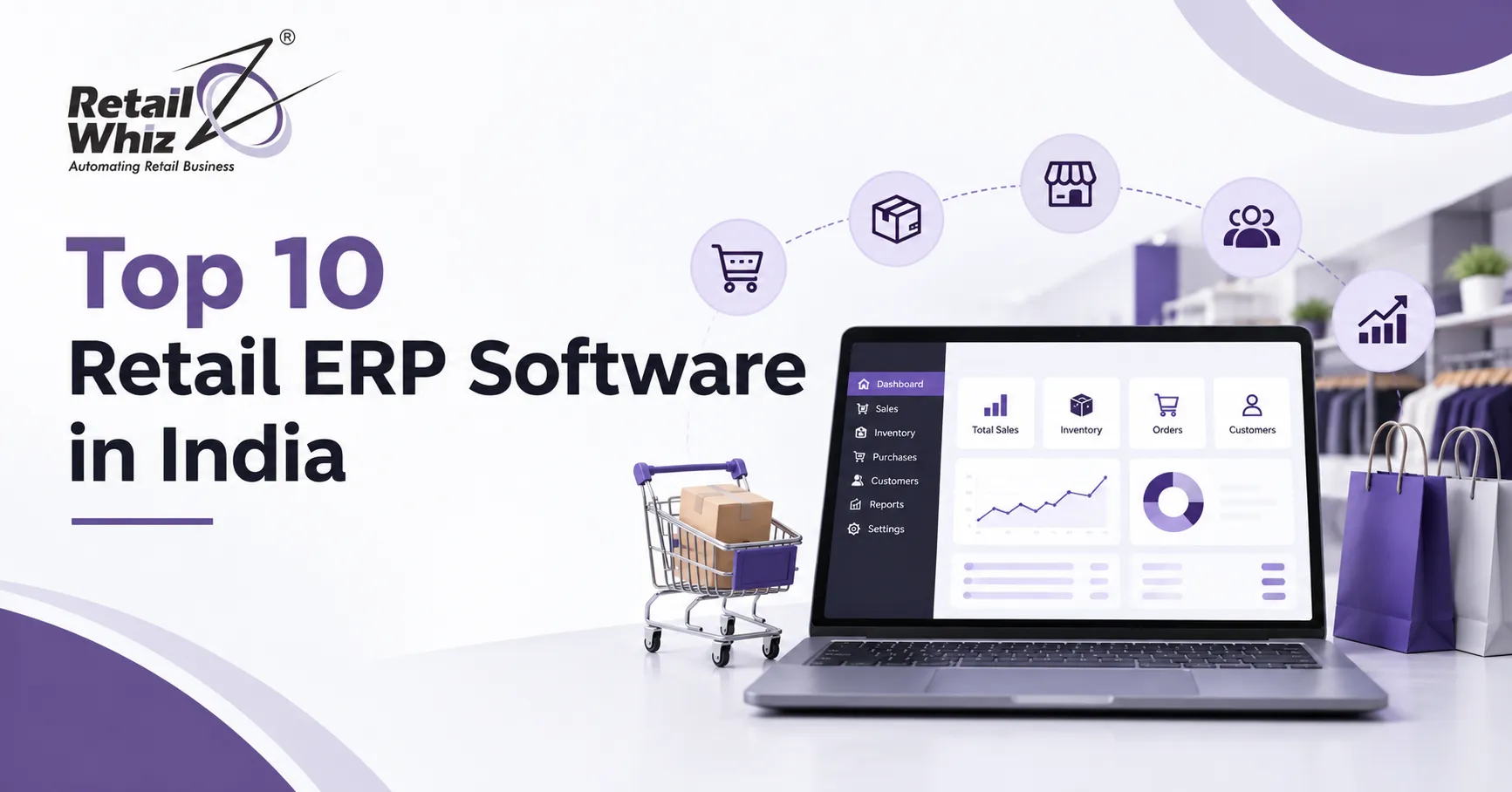
Indian retail is changing fast. Quick commerce, omnichannel shopping, UPI payments and strict GST rules have raised the bar for every store owner. Spreadsheets and standalone billing tools can no longer keep up. That is why more retailers are searching for the best retail ERP software in India to run billing, stock, purchasing, accounting and reporting from one platform.
This guide compares the top 10 retail ERP software in India for 2026. It covers what each platform does well, where it falls short and which type of retailer it suits. Whether you run a single grocery store, a fashion chain or a multi-city supermarket network, this comparison will help you shortlist with confidence.
What Is Retail ERP Software?
Retail ERP software is a unified system that connects your core retail processes: point of sale (POS), inventory, purchasing, accounting, customer loyalty, GST compliance and analytics. Unlike a generic ERP built for factories or service firms, a retail ERP is designed around SKUs, barcodes, batch and expiry tracking, size and colour variants, store-to-store transfers and fast counter billing.
For Indian retailers, a good ERP for retail business should also handle GST invoicing, e-invoicing, HSN codes, multiple price lists and integrations with payment gateways and accounting tools.
Why Indian Retailers Are Moving to Retail ERP in 2026
- Real-time stock visibility: Know what is on every shelf and in every warehouse without manual counts.
- Faster checkout: Barcode scanning, split payments and offline billing cut queue times.
- Multi-store retail management: Control pricing, promotions and transfers across outlets from one dashboard.
- Compliance without stress: Automated GST returns and e-invoicing reduce errors and penalties.
- Better decisions: Sales, margin and SKU-level analytics show what sells and what does not.
- Scalability: Add stores, users and sales channels without changing systems.
If inventory accuracy is your biggest pain point, start by reviewing a dedicated inventory management software module, because stock errors quietly drain margins faster than almost any other retail problem.
Key Features to Look For in a Retail ERP
Before comparing vendors, define your must-haves:
1. POS and billing software with barcode support, offline mode and multiple payment modes
2. Inventory management with batch, expiry, serial number and size-colour tracking
3. Purchase and procurement with vendor management and automatic reorder levels
4. GST billing software features, including e-invoicing and e-way bills
5. Loyalty and promotions such as points, coupons and scheme automation
6. MIS and analytics with store-wise, category-wise and SKU-wise reports
7. Cloud and mobile access so owners can monitor stores from anywhere
8. Integrations with Tally, payment gateways, e-commerce marketplaces and delivery apps
9. Local support because Indian retail runs long hours, including festival peaks
Top 10 Retail ERP Software in India (2026)
1. RetailWhizz
RetailWhizz is a retail-first ERP suite built for Indian businesses, with more than 25 years of experience and over 1,600 retail stores served across India and international markets. It covers POS, inventory, purchase and procurement, loyalty, payment integration, MIS analytics and GST compliance in one connected system, backed by hands-on retail ERP implementation support, and it integrates with more than 30 tools, including Tally, Paytm, Pine Labs and Shopify.
Best for: Supermarkets, hypermarkets, grocery stores, fashion and lifestyle stores, footwear, pharmacy, sweet shops and multi-store chains.
Strengths:
- Industry-specific setups for different retail formats
- Offline billing and real-time inventory sync
- Complete implementation, data migration, training and support services
- Strong GST and e-invoicing support
Consider: Pricing is quote-based, so book a demo to match modules to your store count.
If you want to see how the billing layer compares with other tools, read this detailed breakdown of the best POS software for retail stores in India.
2. Ginesys One
Ginesys One is a well-known Indian retail ERP suite that covers retail finance, wholesale, sales and distribution, e-commerce fulfilment and loyalty. It is popular with mid-size and large apparel, lifestyle and multi-brand retailers who need omnichannel control.
Best for: Fashion, lifestyle and larger retail chains.
Strengths: Deep retail workflows, omnichannel capability, strong brand in the Indian retail ERP space.
Consider: It can be more than a single-store owner needs.
3. GoFrugal
GoFrugal offers ERP and POS solutions for retail, restaurants and distribution. It is widely used by supermarkets, pharmacies and general stores that want a scalable platform with mobile apps and analytics.
Best for: Small to mid-size retailers who want one vendor for POS and back office.
Strengths: Broad product range, mobile access, strong market presence.
Consider: Check which edition includes the modules you need.
4. Marg ERP
Marg ERP is a long-standing name in Indian retail and distribution, with a strong focus on inventory-heavy and billing-intensive businesses such as pharmacies and general trade.
Best for: Medicine shops, distributors and traditional retail.
Strengths: Detailed inventory and GST billing features, familiar to many Indian traders.
Consider: Setup and learning can take longer than with mobile-first billing apps.
5. VasyERP
VasyERP is a cloud-based retail ERP aimed at small and mid-size Indian retailers. It positions itself around easy adoption, AI-assisted insights and multi-location control.
Best for: Growing retailers moving from desktop billing to cloud.
Strengths: Cloud-first design, retail-specific modules.
Consider: Evaluate depth of customisation if you run complex supply chains.
6. LOGIC ERP
LOGIC ERP is an Indian retail and supermarket software provider with integrated POS, inventory and accounting features. It is commonly considered by grocery and supermarket owners who need multi-store billing and stock control.
Best for: Supermarkets and grocery chains.
Strengths: Integrated billing, POS and ERP for multi-store grocery operations.
Consider: Confirm integrations with your preferred payment and accounting tools.
7. SAP Business One
SAP Business One is an ERP for growing mid-market companies, with strong finance, purchasing and reporting. Retailers often pair it with a third-party POS and retail add-ons to cover store-level needs.
Best for: Larger retailers and brands that want a global ERP standard.
Strengths: Robust finance, scalability, global reputation.
Consider: Total cost rises once you add POS, GST automation and retail extensions through partners.
8. Zoho (Zoho Inventory, Zoho Books and Zoho One)
Zoho is a cloud suite rather than a pure retail ERP. Zoho Books handles GST-compliant accounting, and Zoho Inventory manages stock. Zoho One bundles dozens of apps for CRM, finance and operations.
Best for: Cloud-first small businesses and online-heavy retailers.
Strengths: Affordable entry, wide app ecosystem, clean interface.
Consider: Counter-level POS depth for large stores may need add-ons.
9. Microsoft Dynamics 365 Business Central
Business Central is a mid-market ERP with finance, supply chain and sales capabilities. It suits retailers that already use the Microsoft ecosystem and need strong reporting and workflow control.
Best for: Mid-size to large retailers with an IT team or a strong implementation partner.
Strengths: Scalability, Microsoft integration, flexible customisation.
Consider: Implementation planning and partner quality matter a lot.
10. TallyPrime
TallyPrime is India’s most trusted accounting software and handles GST billing, inventory and compliance well. It is not a full retail ERP, but many retailers use it as the accounting backbone and connect it with a retail POS or ERP.
Best for: Small retailers who want accounting first.
Strengths: Familiar to accountants, strong GST support, wide integration options.
Consider: It lacks the full multi-store retail workflows found in dedicated retail ERPs.
Retail ERP Software Comparison Table (2026)
| Software | Best For | Standout Strength | Deployment |
| RetailWhizz | Supermarkets, fashion, multi-store chains | Retail-first suite with GST and offline billing | On-premise / cloud |
| Ginesys One | Apparel and lifestyle chains | Omnichannel retail ERP | Cloud |
| GoFrugal | Small to mid-size retailers | POS plus ERP breadth | Cloud / on-premise |
| Marg ERP | Pharmacies, distributors | Inventory-heavy billing | Desktop / cloud |
| VasyERP | Growing retailers | Cloud-first ease of use | Cloud |
| LOGIC ERP | Supermarkets and grocery | Integrated POS and ERP | Cloud / on-premise |
| SAP Business One | Mid-market and large retail | Finance and scalability | Cloud / on-premise |
| Zoho Suite | Online and small retailers | Affordable cloud apps | Cloud |
| Dynamics 365 Business Central | Mid to large retailers | Microsoft ecosystem | Cloud |
| TallyPrime | Accounting-led small stores | GST and accounting | Desktop / cloud |
Features and deployment options change often, so always confirm current details with each vendor before buying.
How to Choose the Right Retail ERP for Your Business
1. Match the ERP to your retail format. A supermarket needs fast billing, weighing scale support and batch control. A fashion store needs size and colour matrices. A pharmacy needs expiry tracking. Pick software built for your category.
2. Prioritise compliance. Your ERP must support GST invoicing, e-invoicing and return-ready data. Review how well the vendor handles GST and compliance before you sign, because a weak tax module creates audit headaches later.
3. Plan for growth. Choose a platform that can add stores, users and channels without a costly migration.
4. Check total cost of ownership. Look beyond license fees. Include implementation, customisation, hardware, training, support and upgrade costs.
5. Test offline resilience. Internet outages should never stop billing at your counter.
6. Ask for a live demo with your own data. A scripted demo hides gaps. Test your real SKUs, tax rules and reports.
7. Evaluate support and training. Good software fails without good onboarding. Look for vendors that offer data migration, staff training and responsive support.
Tips for a Smooth Retail ERP Implementation
Most ERP failures come from poor rollout, not poor software. Follow these steps:
- Clean your product master data before migration.
- Start with a pilot store, then scale.
- Train cashiers, store managers and accountants separately.
- Set clear success metrics such as billing time, stock accuracy and report turnaround.
- Work with a vendor that offers structured ERP implementation so timelines, data mapping and go-live support are handled by specialists.
Final Verdict
There is no single winner for every store. Large enterprises with complex finance may lean toward SAP Business One or Dynamics 365. Accounting-led small shops may start with TallyPrime or Zoho. For Indian retailers who want one retail-first platform covering POS, inventory, procurement, loyalty, analytics and GST, RetailWhizz is a strong shortlist candidate thanks to its deep retail focus, multi-store capability and end-to-end services. Shortlist three vendors, run live demos with your real data and pick the one your team can adopt quickly.
Frequently Asked Questions (FAQs)
1. What is the best retail ERP software in India in 2026?
The best option depends on your business size and format. RetailWhizz, Ginesys One, GoFrugal, Marg ERP and VasyERP are popular retail-focused choices, while SAP Business One and Dynamics 365 suit larger organisations with complex needs.
2. How is retail ERP different from POS software?
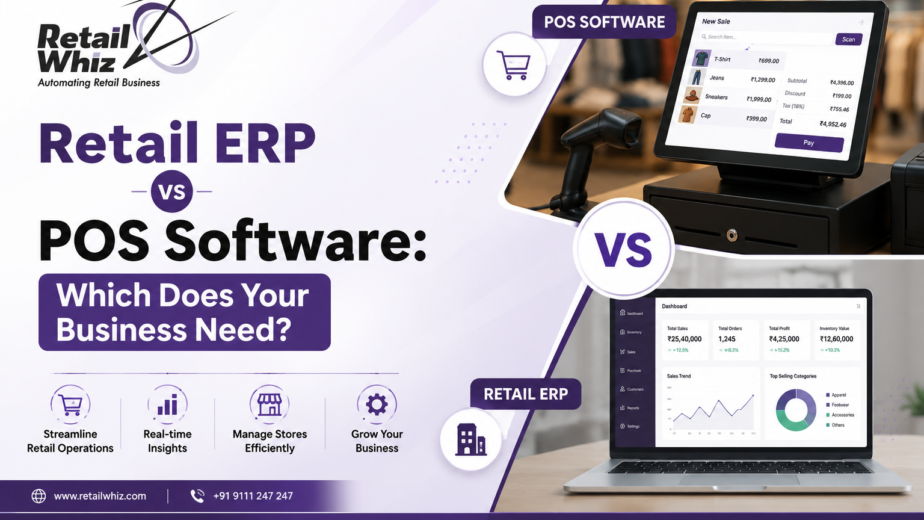
POS software handles billing at the counter. A retail ERP includes POS and connects it with inventory, purchasing, accounting, loyalty, GST and analytics, giving you one version of the truth across all stores.
3. How much does retail ERP software cost in India?
Costs vary widely based on users, stores, modules, deployment type and customisation. Many vendors offer quote-based pricing. Compare license, implementation, training and support costs together to understand the true total cost.
4. Is cloud ERP better than on-premise ERP for retail?
Cloud ERP offers remote access, easier updates and lower upfront cost. On-premise can suit stores that want local control. Many retailers choose a hybrid approach with offline billing so the counter keeps running during internet downtime.
5. Can a retail ERP handle GST and e-invoicing?
Yes. A good retail ERP automates GST-compliant invoices, HSN codes, e-invoicing and return-ready reports. Confirm that the vendor updates the software promptly when tax rules change.