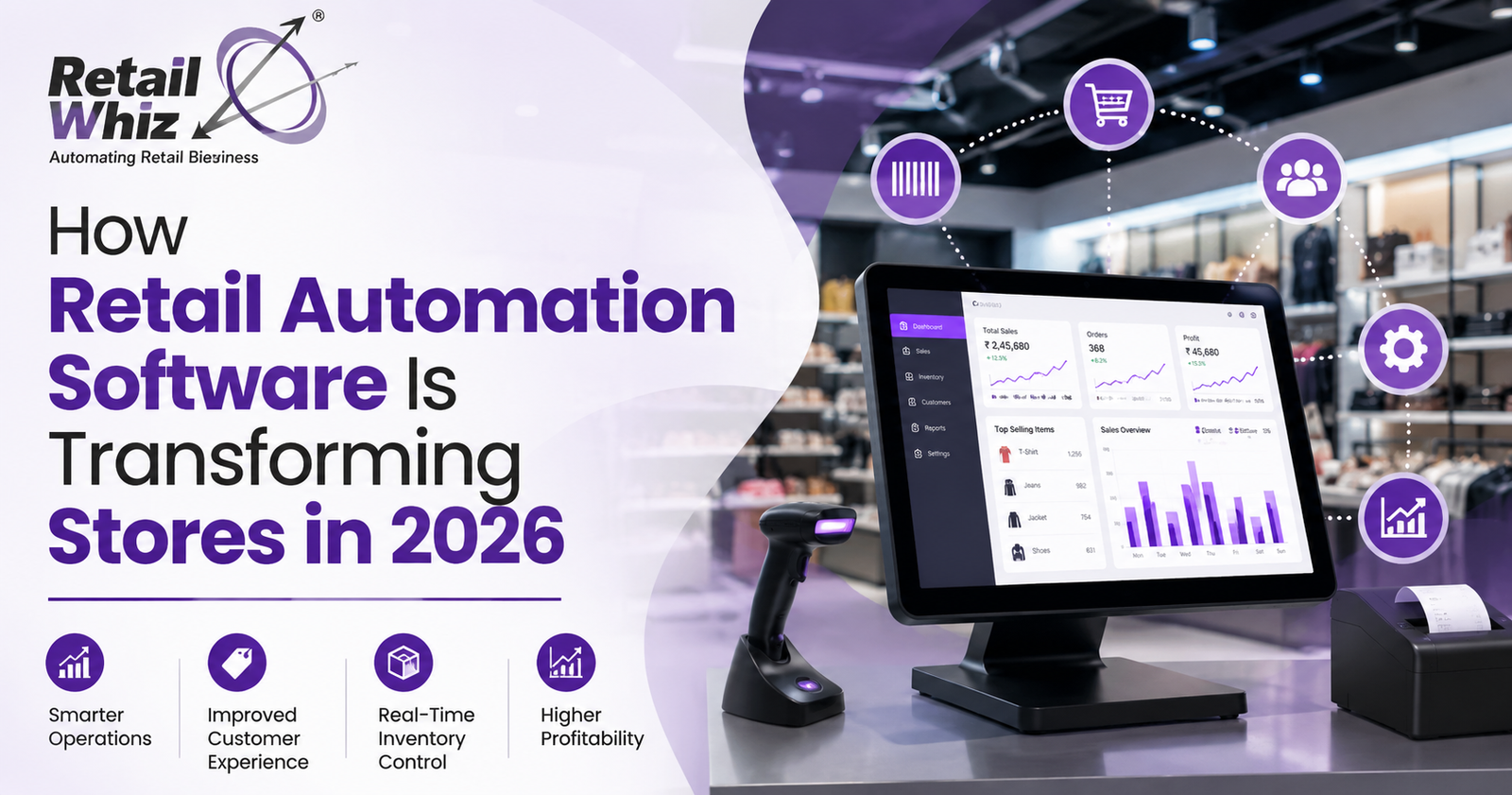
Walk into almost any store today and you will notice something different from just a few years ago. Shorter checkout lines, smarter shelves, personalized offers on your phone the moment you walk in, and stockrooms that seem to always have what you need. None of this happens by accident. It is the result of retail automation software quietly running in the background, connecting every part of the store into one intelligent system.
In 2026, retail automation has moved far beyond simple point of sale systems and barcode scanners. It now touches inventory management, customer experience, workforce scheduling, pricing, and even loss prevention. Retailers who once viewed automation as a “nice to have” are now treating it as the backbone of survival in a market defined by thin margins, rising labor costs, and customers who expect instant, personalized service.
This blog breaks down exactly how retail automation software is reshaping stores in 2026, the technologies driving this shift, and what retailers need to know to stay competitive.
Why Retail Automation Software Matters More Than Ever in 2026
The retail automation market is growing at a rapid pace, driven by rising operational costs, labor shortages, and the demand for faster, more accurate service. Retailers are under constant pressure to do more with less. Automation software solves this by taking repetitive, error-prone manual tasks and handling them with speed and precision that humans simply cannot match at scale.
A few forces are accelerating this shift in 2026:
- Rising labor costs are pushing retailers to automate routine tasks so staff can focus on customer service and high-value work.
- Customers now expect the same speed and personalization they get from online shopping, even in physical stores.
- Supply chain volatility has made real-time inventory visibility a necessity rather than a luxury.
- Competition from digitally native brands is forcing traditional retailers to modernize or risk losing market share.
This is exactly why so many retailers are turning to a dedicated retail automation software solution that can unify their operations under one platform instead of relying on disconnected tools.
Key Ways Retail Automation Software Is Transforming Stores
1. Smarter, Real-Time Inventory Management
Out of stock shelves and overstocked backrooms are two of the most expensive problems in retail. Retail automation software now uses real-time data, demand forecasting, and predictive analytics to keep inventory levels accurate across every channel. Instead of manual stock counts and guesswork, retailers get live visibility into what is selling, what needs replenishment, and what should be marked down before it becomes dead stock.
Automated inventory management software also reduces shrinkage by flagging discrepancies instantly, so retailers catch issues before they become costly losses.
2. Cashierless and Self Checkout Experiences
Self checkout and cashierless technology have matured significantly in 2026. What started as basic self-scan kiosks has evolved into fully automated store formats where customers pick up items and walk out, with payment processed automatically. This shift is not about eliminating jobs entirely. It is about removing bottlenecks during peak hours and letting staff focus on tasks that actually need a human touch, such as customer service, merchandising, and store experience.
Retailers implementing these systems report shorter wait times, higher customer satisfaction, and better labor allocation across shifts.
3. AI-Powered Personalization and Marketing Automation
Generic, one-size-fits-all marketing no longer works. Retail automation software now uses customer behavior, purchase history, and real-time triggers to deliver hyper-personalized offers at exactly the right moment. Automated abandoned cart reminders, personalized loyalty rewards, and location-based promotions are becoming standard practice rather than advanced features.
This level of personalization used to require large marketing teams. Now, automation platforms handle it continuously, at scale, without manual intervention.
4. Agentic AI Taking Over Operational Workflows
One of the biggest shifts in 2026 is the rise of agentic AI in retail. Unlike traditional chatbots that only respond to questions, these AI agents can independently manage tasks such as processing returns, adjusting supply chain workflows, resolving customer complaints, and even repricing products based on demand. This moves automation from being a support tool to becoming an active execution layer within store operations, working around the clock without human oversight for routine decisions.
5. Smart Shelf Monitoring and Loss Prevention
Computer vision and IoT sensors are now widely used to monitor shelf stock levels, detect misplaced items, and flag suspicious activity in real time. This reduces the need for manual shelf audits and helps store managers respond to issues immediately rather than discovering them days later during a routine check.
For retailers managing multiple locations, this kind of automated monitoring is a major step toward consistent store operations without needing to physically visit every site. A well-integrated inventory management system plays a central role in making this level of visibility possible.
6. Workforce Scheduling and Task Automation
Labor is one of the largest costs in retail, and scheduling errors can quickly eat into profits. Automation software now analyzes foot traffic patterns, sales data, and historical trends to generate optimized staff schedules automatically. This ensures stores are neither overstaffed during slow periods nor understaffed during rush hours, improving both cost efficiency and customer experience.
7. Unified, Cloud-Based Retail Platforms
Perhaps the biggest paradigm shift in 2026 is the move away from siloed tools toward unified automation platforms. Instead of juggling separate systems for inventory, point of sale, marketing, and analytics, retailers are consolidating everything into a single cloud-based ecosystem. This creates a seamless flow of data between back-end operations and front-end customer engagement, which is essential for making fast, informed decisions.
Benefits of Retail Automation Software for Modern Stores
Retailers adopting automation in 2026 are seeing measurable improvements across several areas:
- Reduced operational costs through fewer manual errors and optimized labor allocation
- Faster checkout and service times, improving overall customer satisfaction
- Improved inventory accuracy, reducing both stockouts and overstock situations
- Better decision-making through real-time analytics and demand forecasting
- Increased revenue through personalized marketing and dynamic pricing strategies
- Stronger loss prevention through automated monitoring and anomaly detection
These benefits compound over time. A store that automates inventory management, for example, also improves its ability to run accurate marketing promotions, since it always knows what stock is actually available.
Challenges Retailers Should Plan For
Automation is not a plug-and-play fix. Retailers need to think beyond the upfront cost of software or hardware and consider the full picture, including ongoing maintenance, staff training, system integration, and connectivity. The retailers seeing the strongest returns are the ones who model total cost of ownership from the start rather than comparing hardware costs to labor savings in isolation.
It is also worth noting that automation does not eliminate the need for people. It changes what people do. Even in a fully automated store, someone still needs to restock shelves, monitor system uptime, service hardware, and handle customer exceptions that automation cannot resolve on its own. The most successful automated stores in 2026 pair strong technology with intentional staffing strategies rather than treating automation as a total replacement for human involvement.
How to Choose the Right Retail Automation Software
With so many tools available, choosing the right platform can feel overwhelming. Here are a few factors retailers should prioritize:
- Integration capability: The software should connect easily with your existing POS, inventory, and e-commerce systems rather than operating in a silo.
- Scalability: Choose a platform that can grow with your business, whether you operate one store or hundreds of locations.
- Real-time data access: Automation is only as good as the data behind it, so real-time visibility is non-negotiable.
- Ease of use: Staff should be able to use the system with minimal training to avoid disruption during rollout.
- Support and reliability: Since uptime is now a defining success metric for automated retail deployments, reliable vendor support matters as much as the technology itself.
If you are exploring your options, it helps to work with a partner who understands both the technology and the retail industry itself. Our team at RetailWhizz has helped retailers implement automation strategies tailored to their specific operations, from small boutique stores to large multi-location chains.
What This Means for the Future of Retail
The direction is clear. Retail automation software is no longer just about speeding up checkout or tracking inventory. It is becoming the operating system for the entire store, connecting data, people, and processes into one coordinated experience. Retailers who invest in the right automation strategy today are positioning themselves to handle rising customer expectations, tighter margins, and increasing competition without sacrificing service quality.
For a deeper look at how automated inventory systems specifically are reshaping day-to-day store operations, check out our detailed guide on how smart inventory management is changing retail operations.
Final Thoughts
Retail automation software has moved from a competitive advantage to a basic requirement for staying relevant in 2026. From AI-powered personalization to cashierless checkout and agentic workflows, the technology is reshaping how stores operate at every level. The retailers who succeed will be the ones who combine the right technology with thoughtful implementation and a workforce strategy that complements automation rather than competes with it.
Frequently Asked Questions
1. What is retail automation software?
Retail automation software is a digital platform that uses technology such as AI, IoT, and data analytics to automate routine store operations. This includes inventory management, checkout processes, marketing campaigns, and workforce scheduling, reducing manual work and improving accuracy across the business.
2. How is retail automation software different from a standard POS system?
A standard POS system primarily handles sales transactions, while retail automation software goes further by connecting inventory, marketing, workforce management, and analytics into one unified system. It automates decision-making processes rather than just recording sales data.
3. Is retail automation software only useful for large retail chains?
No. While large chains benefit from automation at scale, small and mid-sized retailers also see significant value, especially in areas like inventory accuracy, personalized marketing, and reducing time spent on manual administrative tasks.
4. Does implementing automation mean fewer jobs in retail?
Not necessarily. Automation typically shifts staff responsibilities rather than eliminating jobs entirely. Employees spend less time on repetitive tasks like manual stock counts and more time on customer service, merchandising, and handling exceptions that automation cannot resolve.
5. What should retailers consider before investing in automation software?
Retailers should evaluate integration with existing systems, scalability, real-time data capabilities, ease of use for staff, and the total cost of ownership, including maintenance and support, rather than focusing only on the initial purchase price.