Running a successful retail business requires much more than stocking shelves and serving customers. Today’s retail industry is highly competitive, and every decision-from inventory purchases to staffing and promotions-needs to be backed by accurate data. This is where MIS Reports for Retail become indispensable.
A Management Information System (MIS) transforms raw business data into meaningful insights that help store owners monitor performance, reduce losses, increase profitability, and make informed decisions. Whether you own a single retail outlet or manage multiple stores, tracking the right retail metrics through MIS reports can significantly improve operational efficiency.
In this comprehensive guide, we’ll explore what retail MIS reports are, why they matter, and the key metrics every store owner should monitor to maximize growth.
What are MIS Reports in Retail?
MIS (Management Information System) reports are structured reports generated from retail management software, POS systems, inventory software, ERP solutions, or integrated retail management platforms. These reports consolidate data from various departments-including sales, inventory, procurement, finance, and customer management-to provide actionable insights.
Instead of relying on guesswork, retailers can use MIS reports to answer important questions like:
- Which products generate the highest profit?
- Which store performs best?
- What inventory needs replenishment?
- Which employees achieve the highest sales?
- What are the peak shopping hours?
- Which marketing campaigns produce the best ROI?
The primary objective of retail MIS reporting is to improve decision-making using real-time business intelligence.
Why MIS Reports are Essential for Retail Businesses
Retail businesses generate thousands of transactions every day. Without organized reporting, it becomes difficult to identify trends, detect problems, or capitalize on opportunities.
Some major benefits of retail MIS reports include:
- Better inventory planning
- Improved cash flow management
- Higher sales performance
- Reduced operational costs
- Faster decision-making
- Enhanced customer satisfaction
- Increased profit margins
- Better staff productivity
- Accurate financial monitoring
- Smarter business forecasting
Retailers that actively monitor business performance through MIS reports can respond quickly to changing customer demands and market conditions.
Key Metrics Every Store Owner Must Track
The effectiveness of MIS reporting depends on tracking the right Key Performance Indicators (KPIs). Below are the most important retail metrics every business should monitor.
1. Daily Sales Report
A Daily Sales Report is one of the most frequently used MIS reports in retail.
It provides detailed information about:
- Total sales
- Number of transactions
- Sales by category
- Sales by product
- Sales by payment mode
- Discounts offered
- Returns
- Net revenue
Monitoring daily sales helps retailers identify:
- High-performing days
- Sales trends
- Seasonal demand
- Underperforming categories
This report serves as the foundation for business performance analysis.
2. Gross Profit Margin
Sales alone don’t determine business success. Profitability matters even more.
Gross Profit Margin measures how much profit remains after deducting the cost of goods sold (COGS).
Formula:
Gross Profit Margin = ((Sales – Cost of Goods Sold) ÷ Sales) × 100
Tracking gross margin helps retailers:
- Identify profitable products
- Optimize pricing strategies
- Reduce unnecessary discounts
- Improve purchasing decisions
A high sales volume with a low profit margin may indicate pricing issues.
3. Inventory Turnover Ratio
Inventory is often the largest investment for retailers.
The Inventory Turnover Ratio measures how efficiently inventory is sold during a specific period.
A high turnover indicates:
- Strong product demand
- Healthy inventory management
- Lower holding costs
A low turnover may indicate:
- Overstocking
- Slow-moving products
- Poor purchasing decisions
Monitoring inventory turnover helps reduce dead stock and improve cash flow.
4. Stock Aging Report
Unsold inventory ties up valuable capital.
A Stock Aging Report categorizes inventory based on how long products remain in stock.
Typical categories include:
- 0–30 days
- 31–60 days
- 61–90 days
- 90+ days
Benefits include:
- Identifying dead stock
- Planning clearance sales
- Improving purchasing decisions
- Reducing inventory carrying costs
Retail businesses should regularly review aging reports to maintain healthy inventory levels.
5. Fast-Moving and Slow-Moving Products Report
Every retail store has products that sell quickly and others that remain on shelves for months.
MIS reports identify:
Fast-Moving Products:
- High demand
- Frequent replenishment required
Slow-Moving Products:
- Low sales frequency
- Overstock risk
- Discount opportunities
This report helps optimize inventory investment and shelf space utilization.
6. Top Selling Products Report
Knowing your best-selling products enables smarter purchasing decisions.
This report highlights:
- Best-selling SKUs
- Highest revenue generators
- Seasonal bestsellers
- Category leaders
Benefits include:
- Better inventory planning
- Improved merchandising
- Increased profitability
- Stronger supplier negotiations
Retailers should always ensure these products remain in stock.
7. Sales by Category Report
Retail businesses often sell hundreds or thousands of products.
A category-wise sales report reveals:
- Which categories generate maximum revenue
- Category profitability
- Seasonal demand
- Underperforming product categories
Examples:
- Grocery
- Fashion
- Electronics
- Cosmetics
- Footwear
- Home Decor
This report helps allocate shelf space effectively.
8. Customer Purchase Analysis
Understanding customer buying behavior is essential for retail success.
Customer Purchase Analysis includes:
- Purchase frequency
- Average order value
- Preferred categories
- Repeat purchases
- Customer lifetime value
Benefits:
- Personalized marketing
- Better loyalty programs
- Increased customer retention
- Higher repeat sales
Retail businesses can use this data for targeted promotions.
9. Average Bill Value (ABV)
Average Bill Value measures the average amount spent per transaction.
Formula:
Average Bill Value = Total Sales ÷ Number of Bills
Increasing ABV directly improves revenue without increasing customer footfall.
Strategies include:
- Upselling
- Cross-selling
- Product bundling
- Loyalty offers
Tracking ABV helps evaluate sales effectiveness.
10. Footfall Conversion Rate
Many customers visit stores without making purchases.
The Footfall Conversion Rate measures how many visitors become paying customers.
Formula:
Conversion Rate = (Number of Purchases ÷ Total Visitors) × 100
A low conversion rate may indicate:
- Poor customer service
- High pricing
- Ineffective merchandising
- Product availability issues
Improving conversion rates increases revenue significantly.
11. Employee Sales Performance
Staff productivity has a direct impact on retail sales.
Employee performance reports track:
- Individual sales
- Average bill size
- Upselling performance
- Customer feedback
- Attendance
- Sales targets achieved
Managers can use this data for:
- Incentive planning
- Performance reviews
- Training programs
- Workforce optimization
12. Purchase Report
Purchase reports monitor procurement activities.
Key metrics include:
- Supplier purchases
- Purchase value
- Purchase quantity
- Outstanding orders
- Purchase trends
Benefits:
- Better supplier management
- Cost optimization
- Inventory planning
- Purchase forecasting
13. Supplier Performance Report
Reliable suppliers ensure uninterrupted business operations.
Supplier reports evaluate:
- Delivery timelines
- Product quality
- Purchase costs
- Return percentage
- Order fulfillment accuracy
Retailers can identify the most dependable vendors and improve procurement efficiency.
14. Return and Refund Report
Product returns directly impact profitability.
MIS reports analyze:
- Return reasons
- Refund amount
- Defective products
- Return percentage
- Customer complaints
Monitoring returns helps identify quality issues and improve customer satisfaction.
15. Discount Analysis Report
Discounts increase sales but can reduce profit margins.
This report tracks:
- Total discounts offered
- Employee-wise discounts
- Product-wise discounts
- Campaign effectiveness
- Margin impact
Retailers can prevent unnecessary discounting while maintaining competitiveness.
16. Cash Flow Report
Cash flow determines the financial health of a retail business.
Cash flow reports include:
- Daily collections
- Expenses
- Cash balance
- Bank deposits
- Vendor payments
Healthy cash flow ensures smooth business operations and better financial planning.
17. Multi-Store Performance Report
Businesses operating multiple outlets need centralized reporting.
Multi-store MIS reports compare:
- Store-wise sales
- Inventory levels
- Profitability
- Employee performance
- Customer traffic
Management can identify high-performing stores and replicate best practices across locations.
18. GST and Tax Reports
Compliance is a critical part of retail operations.
MIS software generates tax reports including:
- GST summary
- Tax invoices
- Input tax credit
- Output tax
- Monthly tax liability
Automated tax reporting minimizes manual work and reduces compliance errors.
19. Business Dashboard Report
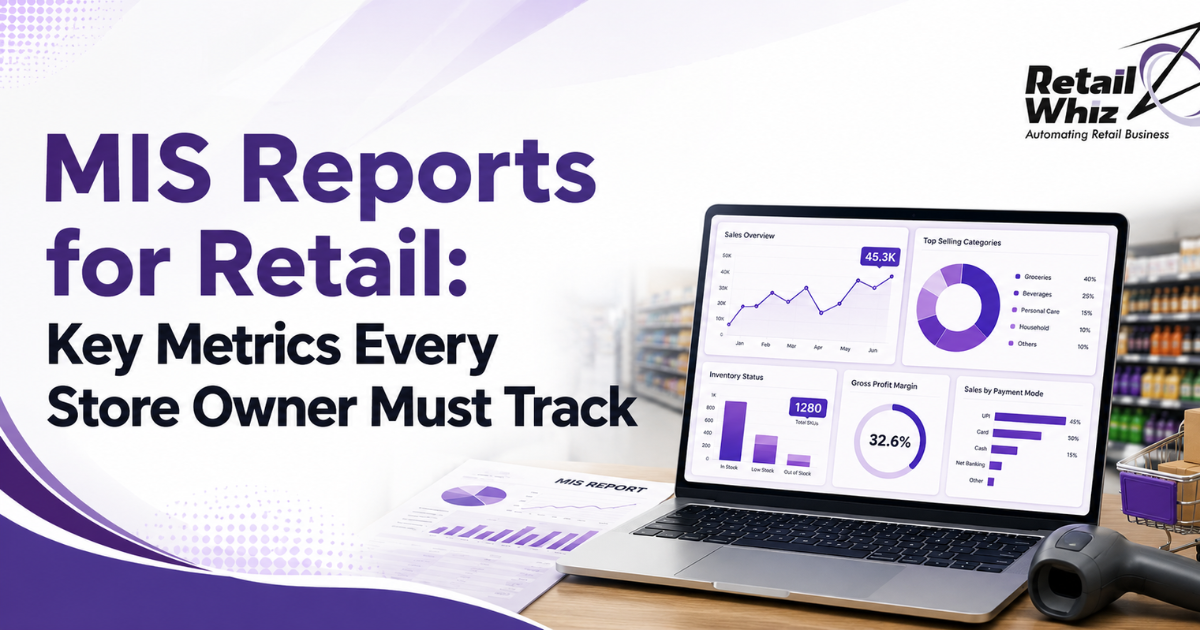
Modern retail software provides dashboards that summarize critical KPIs in real time.
A dashboard typically includes:
- Total sales
- Revenue trends
- Gross profit
- Inventory status
- Best-selling products
- Purchase orders
- Pending payments
- Customer insights
Executives can monitor business performance instantly without reviewing multiple reports.
20. Sales Trend Forecast Report
Historical data can predict future demand.
Sales forecasting helps retailers:
- Plan inventory
- Allocate budgets
- Schedule staff
- Prepare for seasonal demand
- Reduce stock shortages
Accurate forecasting minimizes inventory costs while improving customer satisfaction.
Best Practices for Using Retail MIS Reports
To maximize the benefits of MIS reporting:
- Review reports daily, weekly, and monthly.
- Monitor KPIs consistently.
- Use real-time reporting whenever possible.
- Integrate POS, inventory, accounting, and CRM systems.
- Automate report generation.
- Share reports with department managers.
- Compare historical data to identify trends.
- Use dashboards for faster decision-making.
- Set measurable business goals based on report insights.
- Continuously refine reporting based on business needs.
How Retail MIS Reports Improve Business Growth
Businesses that regularly analyze MIS reports experience measurable improvements across operations. They make smarter purchasing decisions, reduce inventory losses, improve staff productivity, optimize pricing strategies, and enhance customer experiences.
Retail MIS reports also support long-term planning by providing valuable insights into sales trends, seasonal demand, customer preferences, and financial performance. As competition grows, leveraging data-driven reporting becomes a strategic advantage rather than just an operational necessity.
Whether you operate a grocery store, fashion outlet, pharmacy, electronics shop, supermarket, department store, or multi-location retail chain, implementing a robust MIS reporting system helps you stay agile, profitable, and customer-focused.
Conclusion
Retail success today depends on more than intuition-it depends on actionable insights backed by accurate data. By monitoring essential metrics such as daily sales, inventory turnover, gross profit margins, stock aging, customer behavior, employee performance, and cash flow, store owners can make informed decisions that drive sustainable growth.
A well-designed retail MIS reporting system empowers businesses to identify opportunities, address operational challenges proactively, and improve profitability through data-driven strategies. As the retail landscape continues to evolve, investing in comprehensive MIS reporting is no longer optional-it’s a necessity for businesses aiming to stay competitive.
If you’re looking for an intelligent retail management solution with powerful MIS reporting capabilities, retailwhizz can help streamline your operations, provide real-time business insights, and enable smarter decision-making to accelerate your retail business growth.
Frequently Asked Questions (FAQs)
1. What is an MIS report in retail?
An MIS (Management Information System) report in retail is a data-driven report that provides insights into key business operations such as sales, inventory, purchases, customer behavior, employee performance, and financial performance. It helps store owners make informed decisions and improve overall business efficiency.
2. Why are MIS reports important for retail businesses?
MIS reports are important because they provide real-time visibility into business performance. They help retailers track sales trends, manage inventory effectively, reduce operational costs, improve customer satisfaction, optimize staff productivity, and make data-driven decisions that increase profitability.
3. Which are the most important retail KPIs to track in MIS reports?
Some of the most important retail KPIs include daily sales, gross profit margin, inventory turnover ratio, average bill value (ABV), stock aging, sales by category, customer purchase behavior, employee sales performance, return rate, and cash flow. Monitoring these metrics helps retailers improve operational efficiency and business growth.
4. How often should retailers review MIS reports?
Retailers should review different MIS reports at different intervals. Daily reports are ideal for monitoring sales and cash flow, weekly reports help evaluate inventory and employee performance, while monthly reports are useful for analyzing profitability, financial performance, and long-term business trends.
5. Can retail MIS reports help improve inventory management?
Yes, retail MIS reports play a crucial role in inventory management. They help identify fast-moving and slow-moving products, monitor stock aging, prevent stockouts, reduce excess inventory, and improve inventory turnover, ensuring that the right products are available at the right time.
6. How can retail management software improve MIS reporting?
Modern retail management software automates the generation of MIS reports by integrating data from POS systems, inventory management, accounting, and customer databases. This provides real-time dashboards, accurate reporting, faster decision-making, and valuable business insights that help retailers increase efficiency and profitability.